Filters

Changing any of the form inputs will cause the list of events to refresh with the filtered results.

China-Indonesia Relations: 2025 Year in Review and 2026 Outlook – Book Talk

201, May Hall, The University of Hong Kong, or Via Zoom

ABSTRACTThis book examines China–Indonesia relations in 2025, marking 75 years of diplomatic ties amid heightened geopolitical uncertainty. Cooperation across trade, investment, infrastructure, technology—including artificial intelligence (AI)—and defense expanded, even as Indonesia faced challenges in governance and strategic positioning. Indonesia joining BRICS and US tariffs set the tone for the year, shaping expectations around Global South […]

A Century of Language Barriers to Migration in India

Display Area, G/F, May Hall, The University of Hong Kong, or Via Zoom

DESCRIPTION Combining detailed data on language and migration across colonial Indian districts in 1901 with a gravity model, Professor James Fenske of the University of Warwick and his co-authors find that origin and destination districts separated by more dissimilar languages saw less migration. They control for the physical distance between origin-destination pairs, several measures of […]

American Dreams of Chinese Businessmen: U.S. Capital and China’s post-war Economic Reconstruction (1944-1949)

Via Zoom

ABSTRACTForming part of a book project that explores how American capital participated in China’s postwar economic reconstruction, this talk traces three different channels through which Chinese businessmen sought to bring foreign investment into postwar China. The International Business Conference in November 1944 first alerted the Chinese business community to the emerging possibility of mobilizing American […]

​Assortative Mating and the Industrial Revolution: England, 1754-2021

Via Zoom

DESCRIPTION Using a genealogical database of 447,000 people in England 1600-2025, as well as 1.7 million marriage records 1837-2021, Professor Gregory Clark of the University of Southern Denmark and his co-author estimate assortment by social status in marriage. They find the underlying correlation of status between groom and bride in England is remarkably high at […]

When AI Reads Emotions: Affective Computing Approaches to Historical Psychology

201, May Hall, The University of Hong Kong, or Via Zoom

ABSTRACTAcross cultures and centuries, emotions have been expressed, encoded, and preserved in both texts and images. Recent advances in affective computing now offer new opportunities to study these emotional traces at scale. This talk examines how computational approaches to emotion—from early dictionary- and rule-based techniques to contemporary deep learning and large language models—have expanded the […]

A Question of Legacy: Are Asian and European Family Offices Fundamentally Different?

G01, May Hall, The University of Hong Kong

ABSTRACTFamily offices are not a one-size-fits-all solution. Their structure and strategy are deeply influenced by two powerful forces: the generation of wealth they serve and the geographic culture they emerge from. As Asian wealth matures and European dynasties continue, a critical question arises: How do the investment strategies and governance models of these families diverge, […]

The Idea of China: A Contested History

Room 4.36, Run Run Shaw Tower, Centennial Campus

BRIEF INTRODUCTIONAn acclaimed historian’s bold response to two simple, yet vexed, questions: What counts as China, and who counts as Chinese?China became a capitalist superpower by investing in globalization. Now that it has established its credentials—and emerged as a major US competitor—its leaders are looking within, focused on suppressing dissent and fostering cohesion. The result […]

Stone Grinding as New Military Technology: How Early Complex Societies Rose in Neolithic China

201, May Hall, The University of Hong Kong, or Via Zoom

ABSTRACTThis study examines how stone-grinding technology accelerated the growth of complex societies in Neolithic China (8000–2000 BCE) primarily through the war channel rather than the productivity channel. Utilizing data from the China Archaeological Database (CADB), where large settlements (≥10 hectares) indicate complex societies and stone weapon grave goods proxy stone grinding’s battlefield applications, we find […]

Blood and Iron: Political Fragmentation in the Ancient Eastern Mediterranean

Via Zoom

DESCRIPTION In this Quantitative History Webinar, Patrick Fitzsimmons of the University of Pennsylvania will present a theory of how lowering the cost of doing violence around 1200 BCE contributed to political fragmentation across the Eastern Mediterranean. He points out that bronze’s reliance on scarce tin concentrated the means of violence among elites, supporting large, centralized empires, while the […]

Entrepreneurship and Leadership in the Finance Profession: A Fireside Chat

G01, May Hall, The University of Hong Kong

ABSTRACTSuccessful entrepreneurs learn to grow and adapt to different situations and environments as they build their start-ups in an evolving world. Leadership is important in bringing together different parties with different interests to achieve a singular goal. For this iteration of the HKU Family Wealth Lecture Series, we bring a veteran entrepreneur, who started a […]

Pioneers in a Distant Land: The Overseas Chinese Business Community in South America, 1960-2000

Via Zoom

ABSTRACT In the post-2020 era, South America has become a key arena for Chinese global enterprise, with Chinese goods and services achieving unprecedented popularity. This presentation argues that the groundwork for this contemporary success was not only laid by recent state-led initiatives, but also by a much earlier, understudied phenomenon: the rise of the first-generation […]

Roundtable Workshop on ‘Fairbank in China Now: Contemporary Academic and Policy Legacies’

Room 4.36, Run Run Shaw Tower, Centennial Campus

BRIEF INTRODUCTION Though he died 35 years ago, the Harvard historian John Fairbank remains alive through the influence of his ideas, students and image as a major figure in US-China relations.  The workshop will survey the current state of interest in Fairbank in mainland China. Which of his ideas have resonance in contemporary scholarship? What […]

Recasting the National Fengshui Master: Local Knowledge, Textual Authority, and Centralized Order in the Ming Dynasty (1368-1644)

201, May Hall, The University of Hong Kong, or Via Zoom

ABSTRACT This talk investigates how local constructions of the “national fengshui master” (guoshi 國師) reshaped geomantic discourse in the Ming in ways that indirectly reinforced the imperial model of centralized control. Before the fourteenth century, guoshi referred primarily to Buddhist and Daoist court preceptors. In Ming local writings, however, the title was retrospectively applied to […]

Innovation Networks in the Industrial Revolution

Via Zoom

DESCRIPTION In this Quantitative History Webinar, Lukas Rosenberger of Ludwig-Maximilians-Universität Munich will introduce a new approach to understanding technological progress and economic growth during the Industrial Revolution by combining modern growth theory with detailed micro-data. Lukas and his co-authors develop a multi-sector endogenous growth model to study one leading theory of British advantage during the […]

Local Lore of a Sacred Landscape: The Daoist Tradition of Peach Blossom Spring

Lecture Hall, G/F, May Hall, The University of Hong Kong, or Via Zoom , Hong Kong

ABSTRACT Daoist priests in central and northern Hunan Province (PRC), an area known as Plum Mountain (Meishan 梅山), are the custodians of many local traditions. Among them is an ancient and elaborate ritual dedicated to a sacred site famous since medieval times: Peach Blossom Spring (Taohuayuan 桃花源), or Peach Spring Grotto (Taoyuandong 桃源洞), locally also […]

Transport and the Transmission of Plague across Settlements in Early Modern England

Via Zoom

Description Plague was the most lethal disease in early modern England. However, there is limited large-scale quantitative evidence about the factors that allowed plague to spread between settlements. In this Quantitative History Webinar, Eric B. Schneider of the London School of Economics and Political Science will present a study using a novel dataset of aggregated […]

Flora, Cosmos, Salvatio: Pre-modern Academic Institutions and the Spread of Ideas

Via Zoom

Description While good ideas can emerge anywhere, it takes a community to develop and disseminate them. In this Quantitative History webinar, David de la Croix of UCLouvain will reconstruct how interpersonal connections formed through institutional affiliations across premodern Europe (1084–1793), where roughly 200 universities and 150 academies of sciences housed thousands of scholars and produced […]

Mule Carts in Beijing: Knowledge and Ignorance in Transportation Planning in the 1950s

Via Zoom

ABSTRACT Economic planning in socialist China required the local planners to gather comprehensive information within their jurisdiction on one hand and implement centrally issued plan on the other. The dual challenge of knowing the real economy and following ever shifting policy targets is particularly daunting in pre-mechanized sectors. Taking the 1950s Beijing transportation as a […]

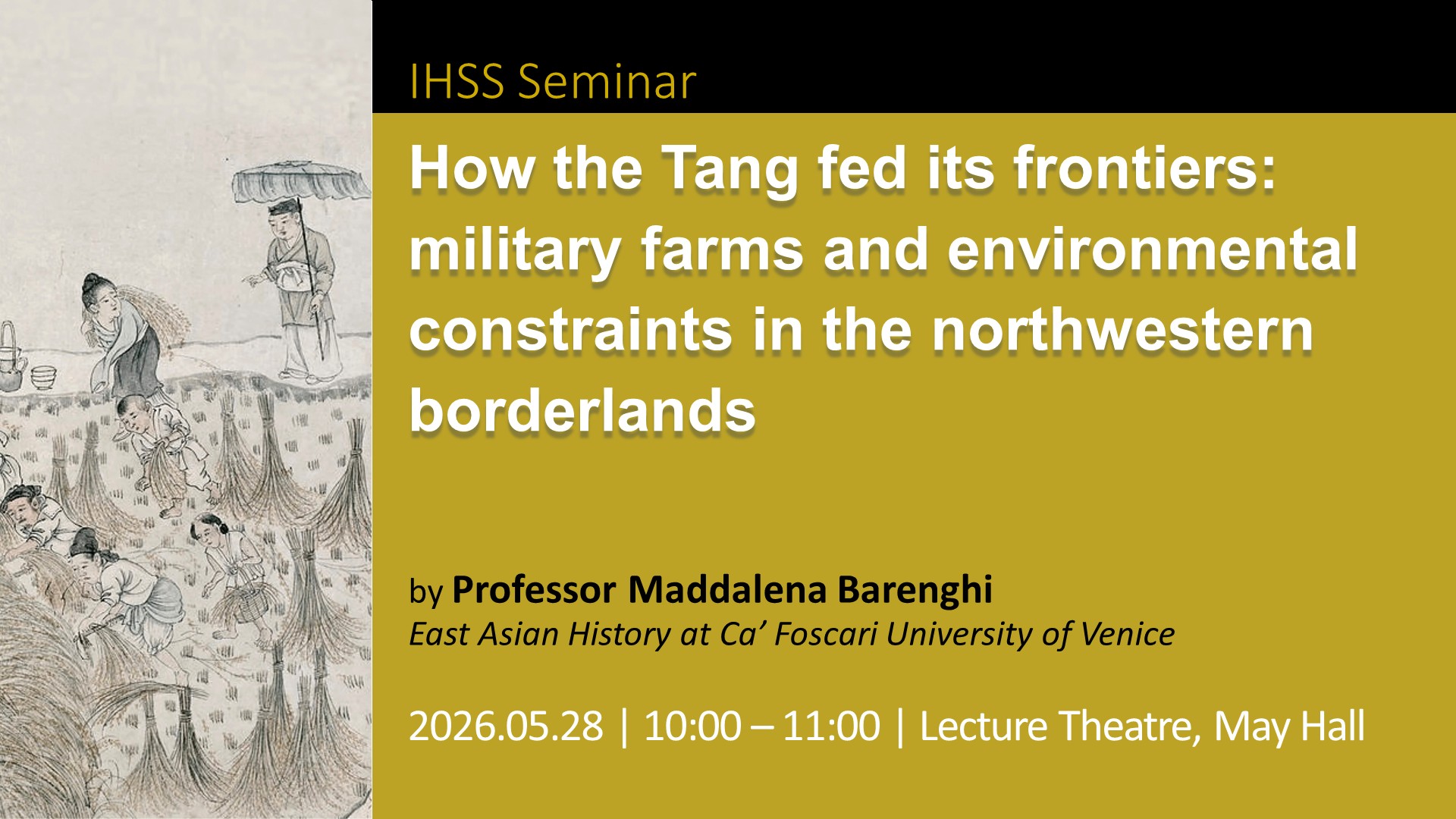
How the Tang fed its frontiers: military farms and environmental constraints in the northwestern borderlands

G01, May Hall, The University of Hong Kong

Description During the first millennium of imperial history, East Asian empires expanded into the semi-arid zones of Inner Asia and established agricultural settlements to sustain frontier garrisons. Under the tuntian system, soldier-farmers cultivated land to provision troops and livestock. A comprehensive analysis of how this agricultural system operated and its limits, accounting for environmental and […]