Description
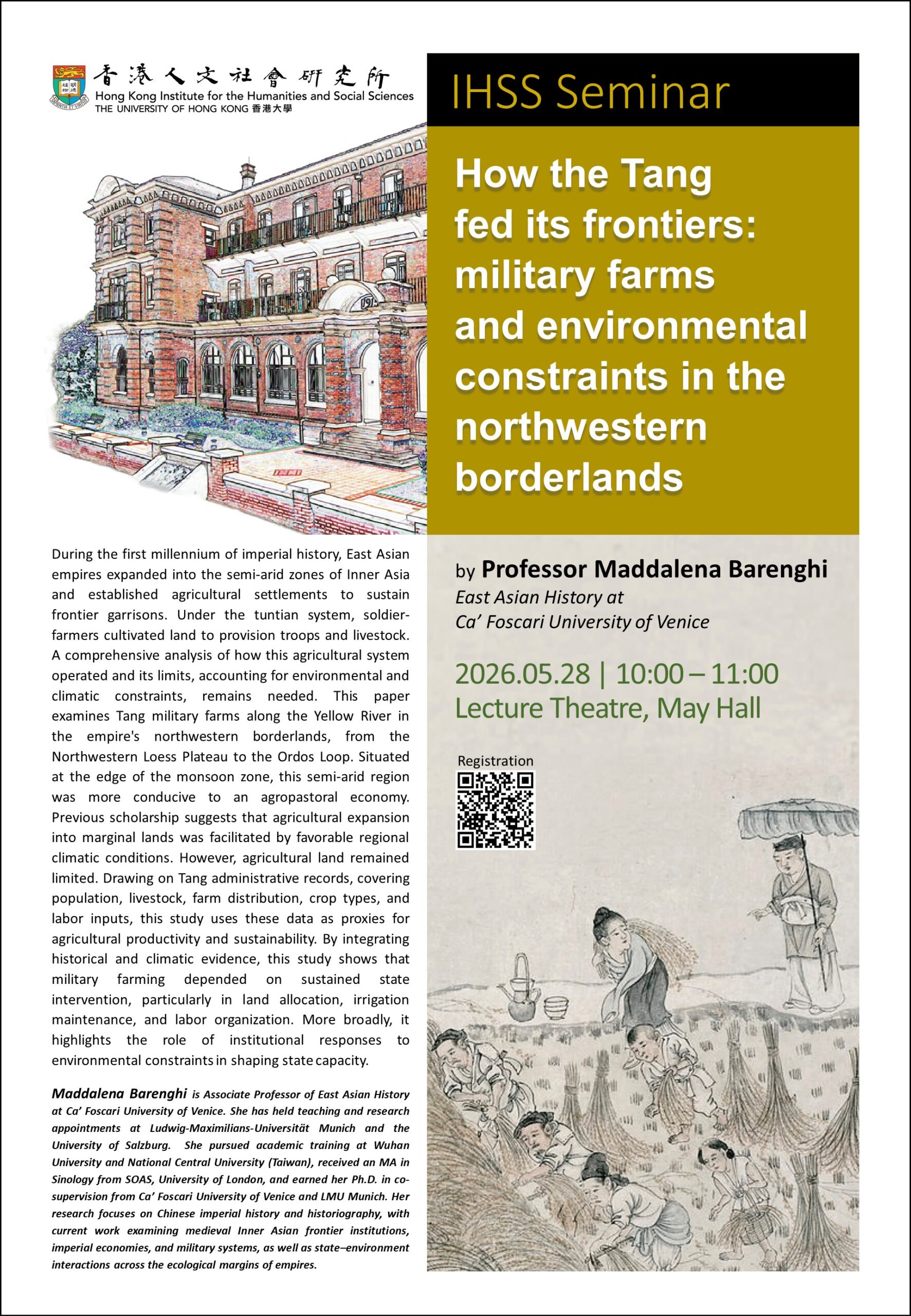
During the first millennium of imperial history, East Asian empires expanded into the semi-arid zones of Inner Asia and established agricultural settlements to sustain frontier garrisons. Under the tuntian system, soldier-farmers cultivated land to provision troops and livestock. A comprehensive analysis of how this agricultural system operated and its limits, accounting for environmental and climatic constraints, remains needed. This paper examines Tang military farms along the Yellow River in
the empire’s northwestern borderlands, from the Northwestern Loess Plateau to the Ordos Loop. Situated at the edge of the monsoon zone, this semi-arid region was more conducive to an agropastoral economy. Previous scholarship suggests that agricultural expansion into marginal lands was facilitated by favorable regional climatic conditions. However, agricultural land remained limited. Drawing on Tang administrative records, covering population, livestock, farm distribution, crop types, and labor inputs, this study uses these data as proxies for agricultural productivity and sustainability. By integrating historical and climatic evidence, this study shows that military farming depended on sustained state intervention, particularly in land allocation, irrigation maintenance, and labor organization. More broadly, it highlights the role of institutional responses to environmental constraints in shaping state capacity.
About the Speakers
Maddalena Barenghi is Associate Professor of East Asian History at Ca’ Foscari University of Venice. She has held teaching and research appointments at Ludwig-Maximilians-Universität Munich and the University of Salzburg. She pursued academic training at Wuhan University and National Central University (Taiwan), received an MA in Sinology from SOAS, University of London, and earned her Ph.D. in co-supervision from Ca’ Foscari University of Venice and LMU Munich. Her research focuses on Chinese imperial history and historiography, with current work examining medieval Inner Asian frontier institutions, imperial economies, and military systems, as well as state–environment interactions across the ecological margins of empires.