Table of Contents
Abstract
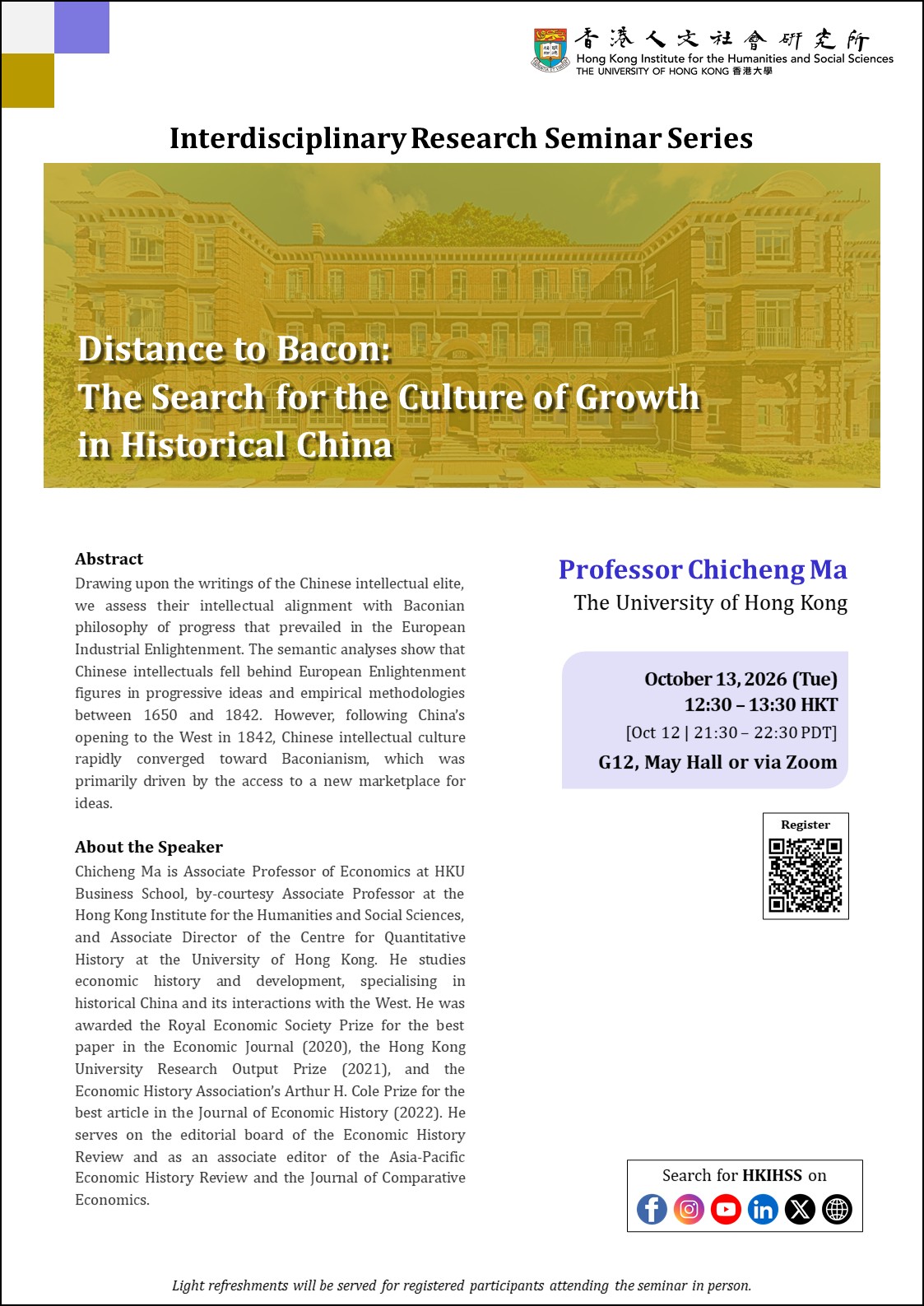
Drawing upon the writings of the Chinese intellectual elite, we assess their intellectual alignment with Baconian philosophy of progress that prevailed in the European Industrial Enlightenment. The semantic analyses show that Chinese intellectuals fell behind European Enlightenment figures in progressive ideas and empirical methodologies between 1650 and 1842. However, following China’s opening to the West in 1842, Chinese intellectual culture rapidly converged toward Baconianism, which was primarily driven by the access to a new marketplace for ideas.
About the Speaker
Chicheng Ma is Associate Professor of Economics at HKU Business School, by-courtesy Associate Professor at the Hong Kong Institute for the Humanities and Social Sciences, and Associate Director of the Centre for Quantitative History at the University of Hong Kong. He studies economic history and development, specialising in historical China and its interactions with the West. He was awarded the Royal Economic Society Prize for the best paper in the Economic Journal (2020), the Hong Kong University Research Output Prize (2021), and the Economic History Association’s Arthur H. Cole Prize for the best article in the Journal of Economic History (2022). He serves on the editorial board of the Economic History Review and as an associate editor of the Asia-Pacific Economic History Review and the Journal of Comparative Economics.
About the Interdisciplinary Research Seminar
This series aims to introduce a wide range of cutting-edge research in various disciplines and areas. If you have any questions about the Interdisciplinary Research Seminar or would like to be removed from this mailing list, please contact Professor Chun Fung Tong (tong.chunfung@hku.hk).