Description
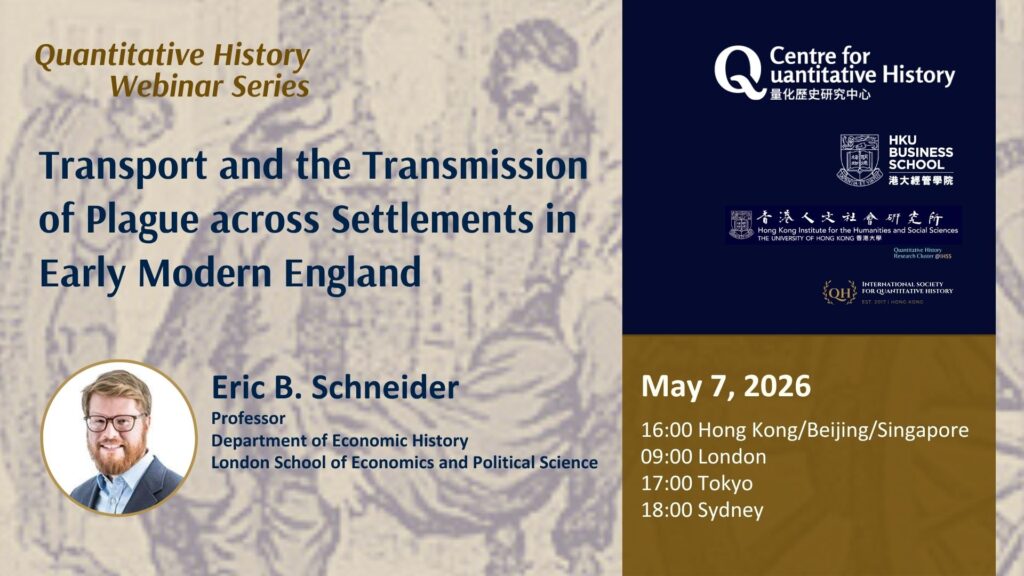
Plague was the most lethal disease in early modern England. However, there is limited large-scale quantitative evidence about the factors that allowed plague to spread between settlements. In this Quantitative History Webinar, Eric B. Schneider of the London School of Economics and Political Science will present a study using a novel dataset of aggregated monthly burial totals covering more than 4,000 parishes between 1557 and 1667. Eric and his co-authors measure how frequently settlements experienced plague epidemics and analyses the factors leading to outbreaks—particularly whether the transmission of plague was affected by the transport network. They find that plague affected relatively few settlements in this period, did not spread in the characteristic wave of the Black Death, and was not strongly linked to transport. Settlements on arterial roads running from London to other major towns had an increased chance of experiencing a plague outbreak, while settlements on other principal roads and along rivers did not. They also find that spillovers from locations on arterial roads were non-existent. Taken together, these results suggest that plague was not spreading via sustained human-to-human transmission in England in our period. The low share of settlements affected also contrasts strikingly with both the Black Death and with early modern plague epidemics on the continent, such as those in Northern Italy in the 1630s. Overall, their evidence indicates that the transport network was not a primary driver of plague spread, highlighting that the rat–flea transmission chain of plague could be broken with only partially effective quarantines.
Eric B. Schneider’s co-authors: Charles Udale (London School of Economics and Political Science), Max Satchell (University of Cambridge), and Henry Yeomans (University of Leeds)
Discussants: Hanzhi Deng, Assitant Professor, Institute for Advanced Study in Social Sciences, Fudan University, and Xiaowen (Oliver) Zhou, PhD candidate, Institute of Neurology, Fudan University Huashan Hospital
About the Series
The Quantitative History (QH) Webinar Series aims to provide researchers, teachers, and students with an online intellectual platform to keep up to date with the latest research in the field, promoting the dissemination of research findings and interdisciplinary use of quantitative methods in historical research. The QH Webinar Series, now entering its sixth year, is co-organized by the Centre for Quantitative History at the HKU Business School and the International Society for Quantitative History in partnership with the Hong Kong Institute for the Humanities and Social Sciences. The Series is now substantially supported by the Areas of Excellence (AoE) Scheme from the Research Grants Council of the Hong Kong Special Administrative Region, China (Project No. [AoE/B-704/22-R]).
量化歷史網上講座系列由香港大學陳志武和馬馳騁教授聯合發起,旨在介紹前沿量化歷史研究成果、促進同仁交流,推廣量化方法在歷史研究中的應用。本系列講座由香港大學經管學院量化歷史研究中心和國際量化歷史學會承辦,及香港人文社會研究所全力支持。從2023年開始,系列得到中國香港特別行政區研究資助局卓越學科領域計劃的重要資助 (項目編號[AoE/B-704/22-R])。
Conveners: Professors Zhiwu Chen & Chicheng Ma (HKU Business School)