Description
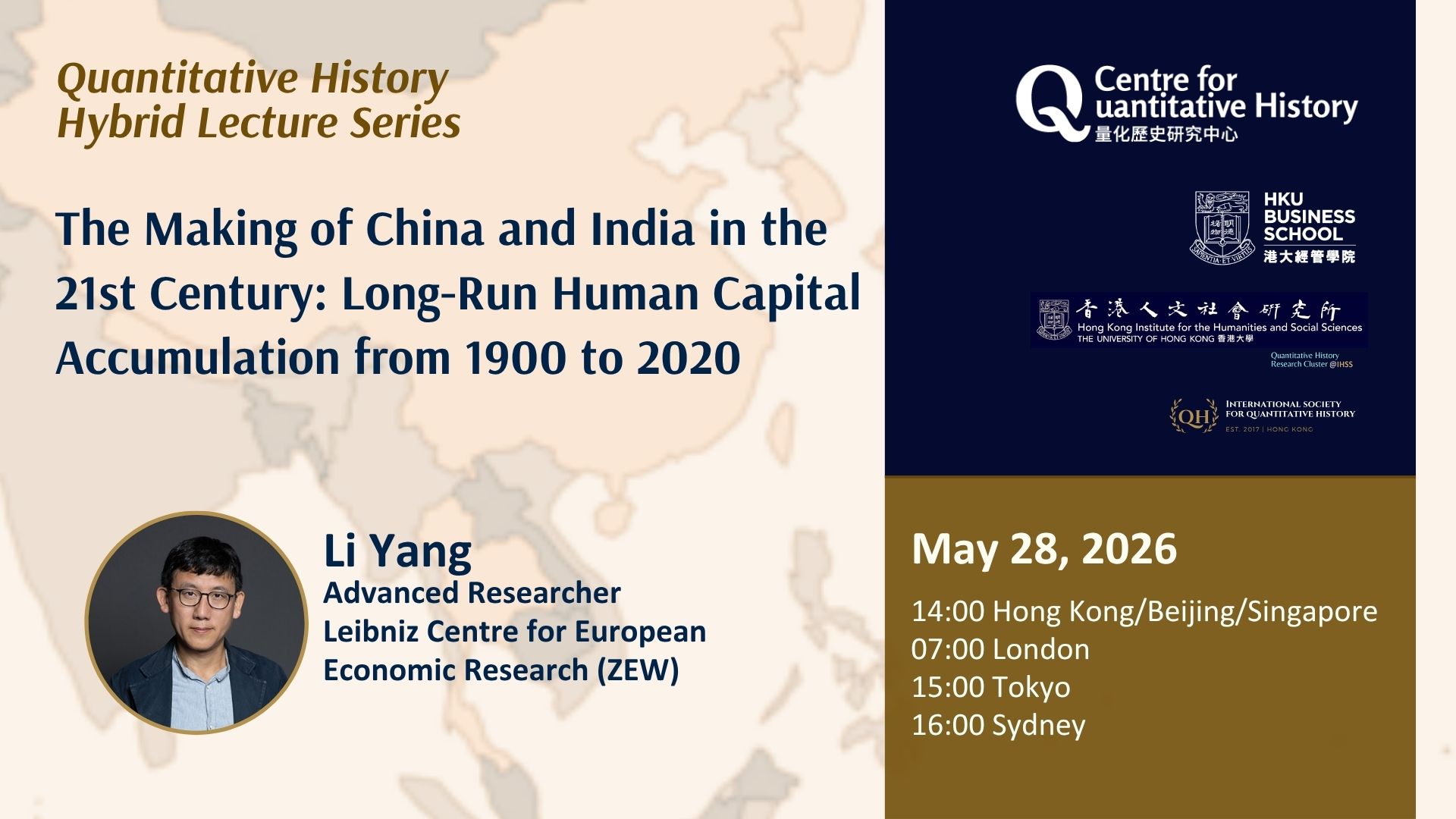
In this Quantitative History hybrid lecture, Li Yang of the Leibniz Centre for European Economic Research (ZEW) will present new evidence on the divergence in economic growth between China and India from the 1980s onward, focusing on how human capital accumulation evolved in each country. The talk will draw on a novel dataset covering 120 years, compiled from a wide range of historical educational reports and surveys. The findings show that China and India pursued notably different strategies in expanding education, including differences in the timing of mass primary schooling, the diversification of secondary and post-secondary pathways, and the ways policymakers managed the quantity–quality trade-off. Using nationally representative household surveys from both countries, the study demonstrates that these divergent educational strategies produced substantial differences in aggregate human capital stocks. These differences, in turn, shaped patterns of wage inequality and influenced the pace and character of economic transition after trade and market liberalization in the 1980s.
The lecture will also be livestreamed on Zoom as part of the Quantitative History Webinar Series.
About the Quantitative History Lecture Series
The Quantitative History Lecture Series is substantially supported by the Areas of Excellence (AoE) Scheme from the Research Grants Council of the Hong Kong Special Administrative Region, China (Project No. [AoE/B-704/22-R]).