Hong Kong Workshop on Early Development History
G01, May Hall, The University of Hong KongJointly organized by HK Institute for the Humanities and Social Sciences and Centre for Quantitative History

Jointly organized by HK Institute for the Humanities and Social Sciences and Centre for Quantitative History
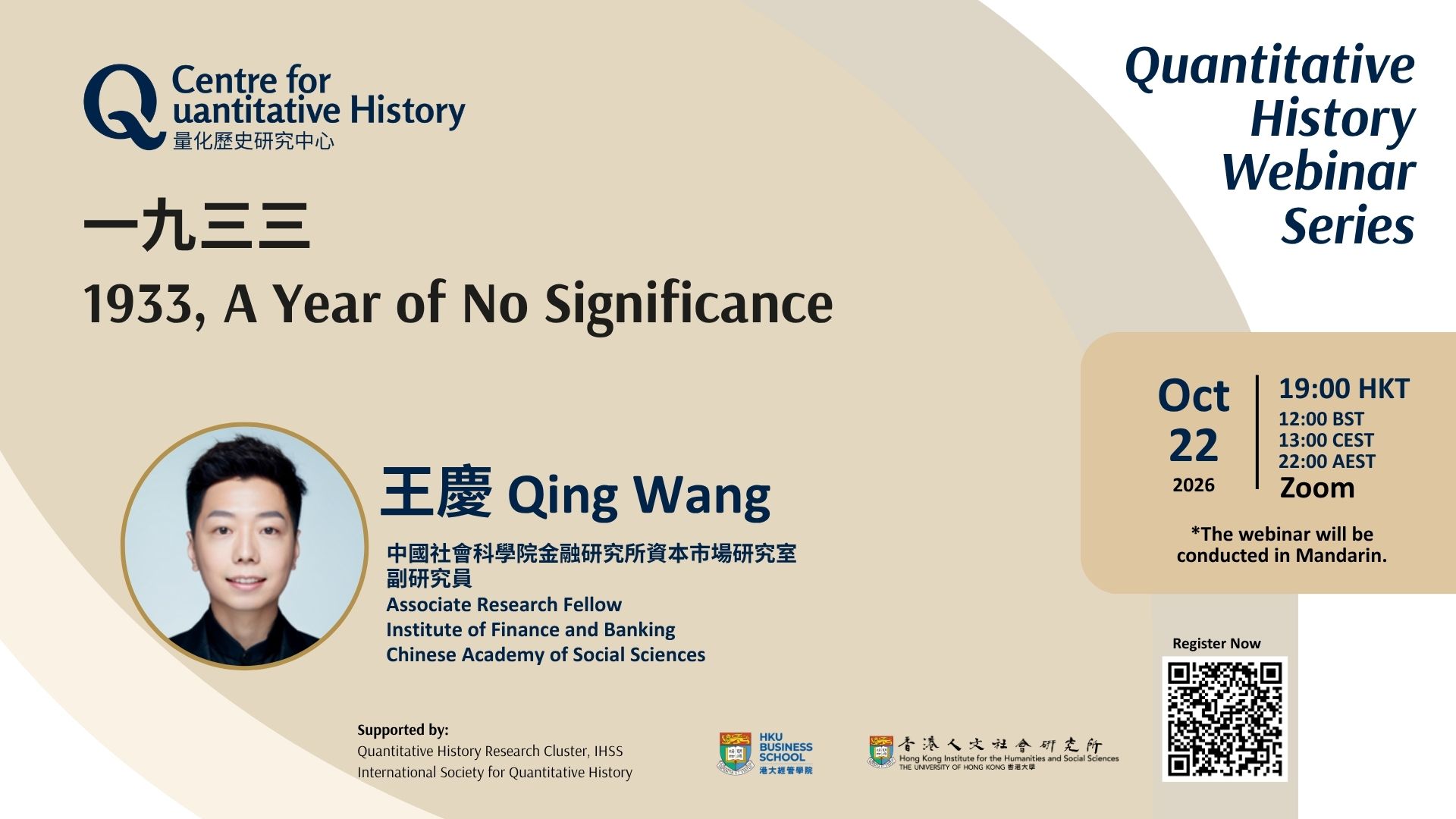
在本次量化歷史網上講座中,王慶將介紹本研究的出發點、主要方法以及主要發現,從存量視角重新審視 1933 年中國的社會經濟格局,為理解中國的現代化進程提供新的經驗證據與分析思路。
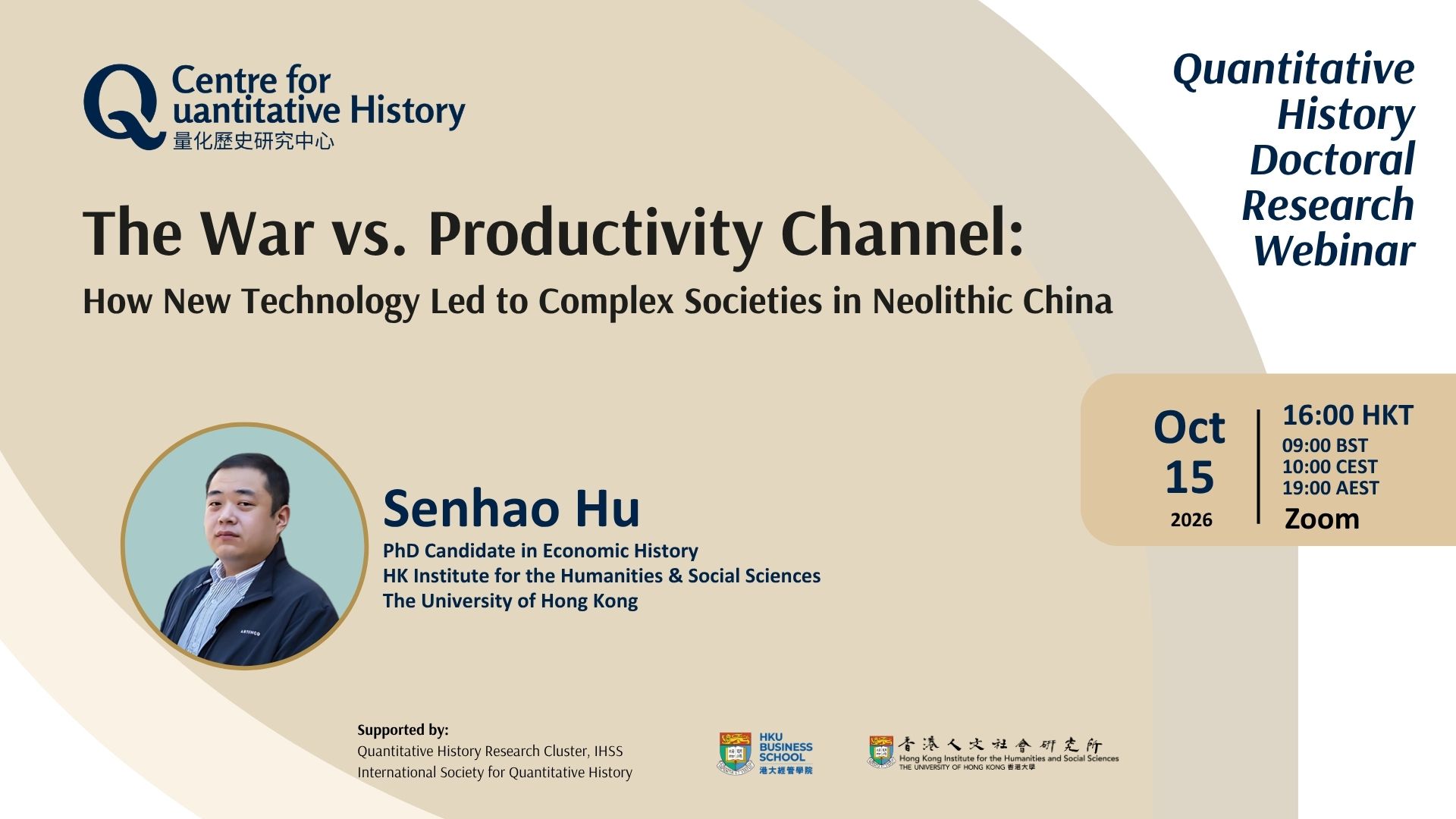
Table of Contents Description In this Quantitative History Webinar, Senhao Hu of Hong Kong Institute for the Humanities and Social Sciences (IHSS) will examine how ground-stone technology contributed to the rise of complex societies during the Neolithic.The standard account—rooted in Gordon Childe’s productivity-channel hypothesis—argues that grinding improved farming implements and increased agricultural productivity, thereby generating […]
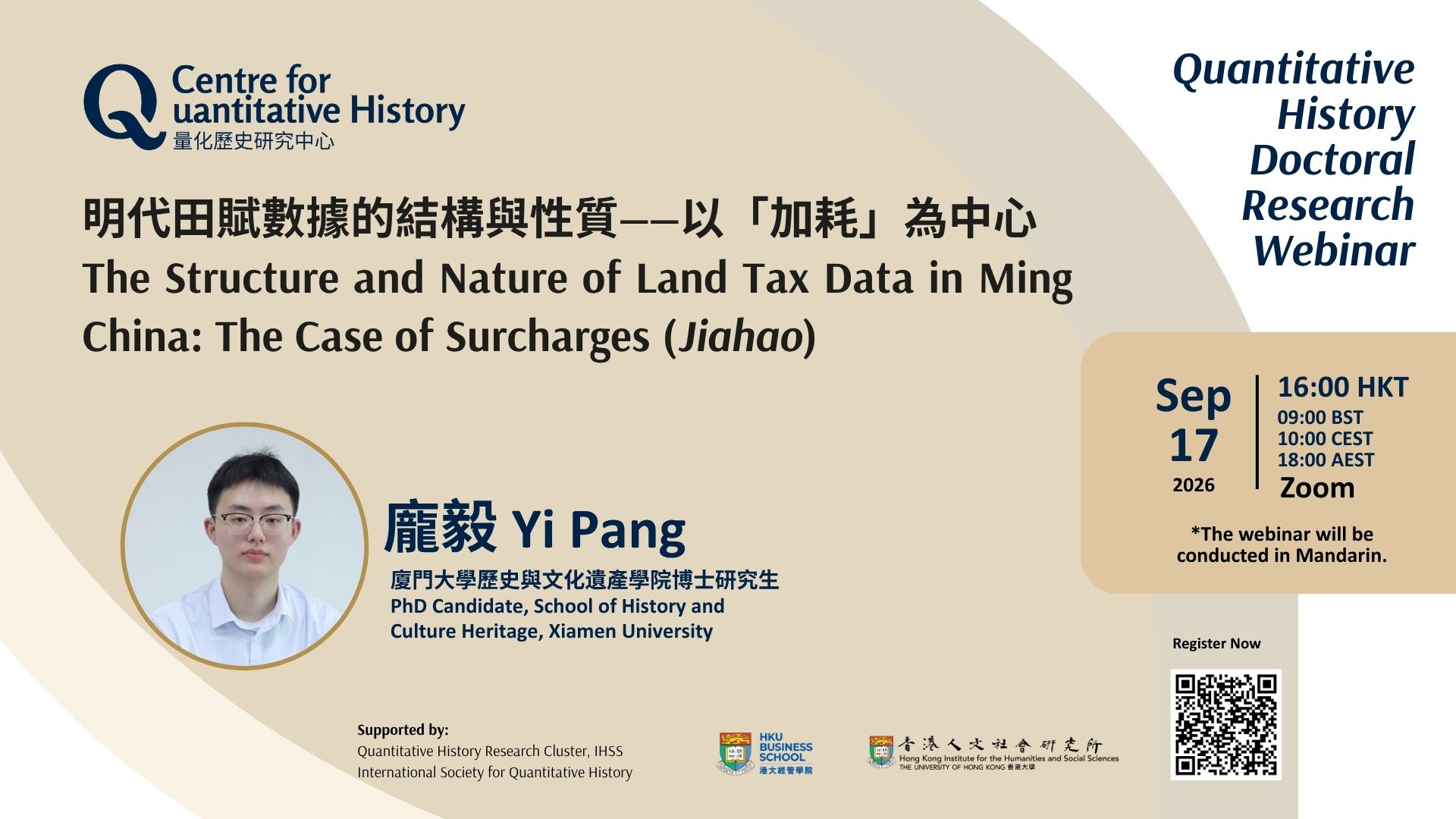
Table of Contents Description 明代田賦數據的結構與性質——以「加耗」為中心 明代田賦數據普遍存在結構性缺失,這在「加耗」這一問題上得以集中體現。 加耗的遺漏,導致明代田賦數據難以反映真實稅制全貌。 這些不完整數據的背後,其實是中央與地方財政會計視角的根本差異,中央政府只關注入庫淨額的「歲入」,而地方政府需負擔包括加耗在內的全部「稅負」。 廈門大學歷史與文化遺產學院博士研究生龐毅通過計算加耗率,更清晰地闡述明代田賦數據的結構與性質,以及恢復地方政府的實際稅額。 The Structure and Nature of Land Tax Data in Ming China: The Case of Surcharges (Jiahao) Ming land tax data are characterised by widespread structural omissions, most clearly illustrated by the exclusion of surcharges (jiahao). These omissions limit the extent to which the data capture […]
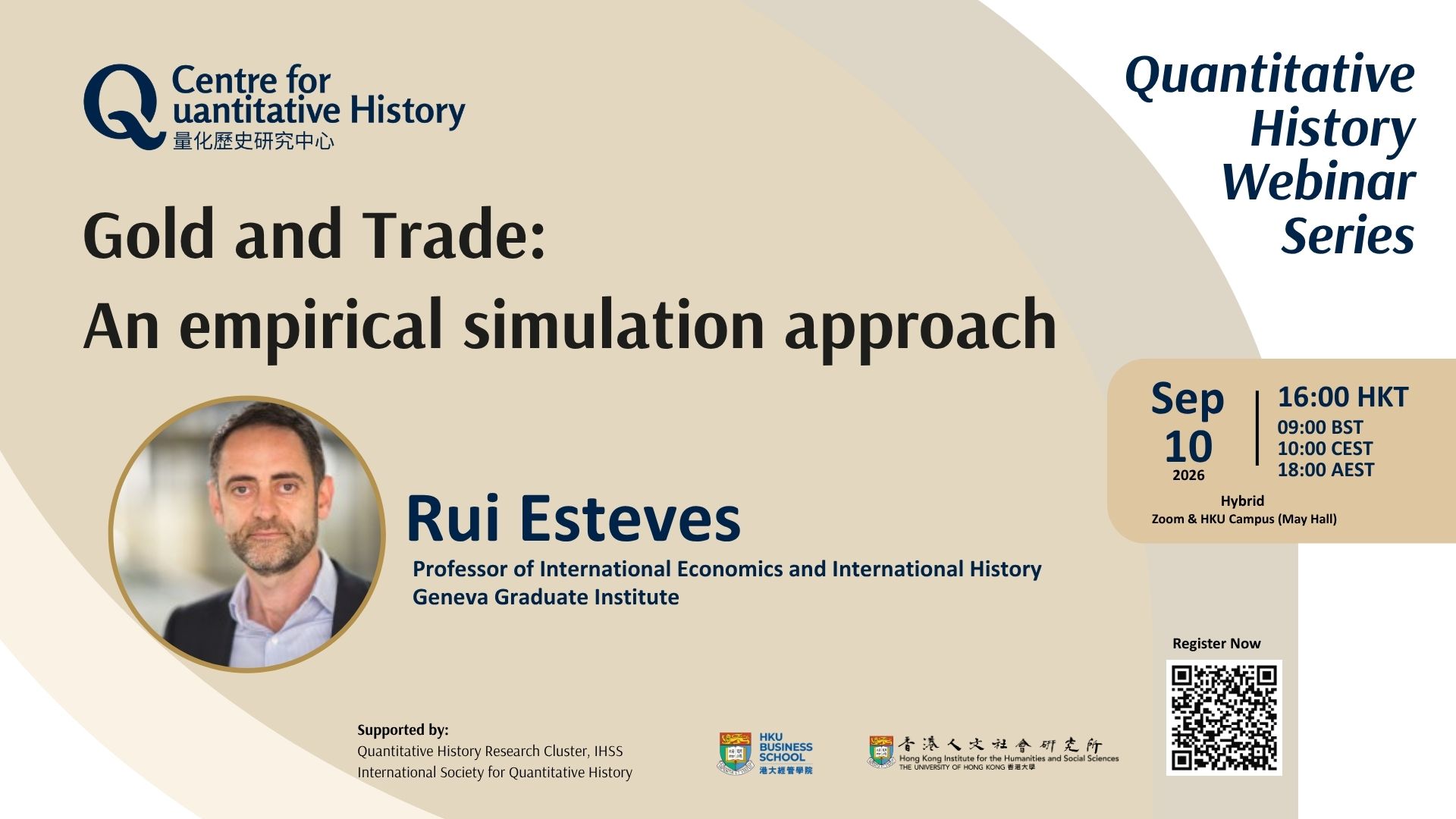
Table of Contents Description Rui Esteves of Geneva Graduate Institute and his co-authors examine the rise of the classical gold standard from the 1860s to World War I through the reciprocal relationship between trade and monetary regimes. Existing gravity estimates cannot identify this relation cleanly because trade and regime choice are jointly endogenous and […]
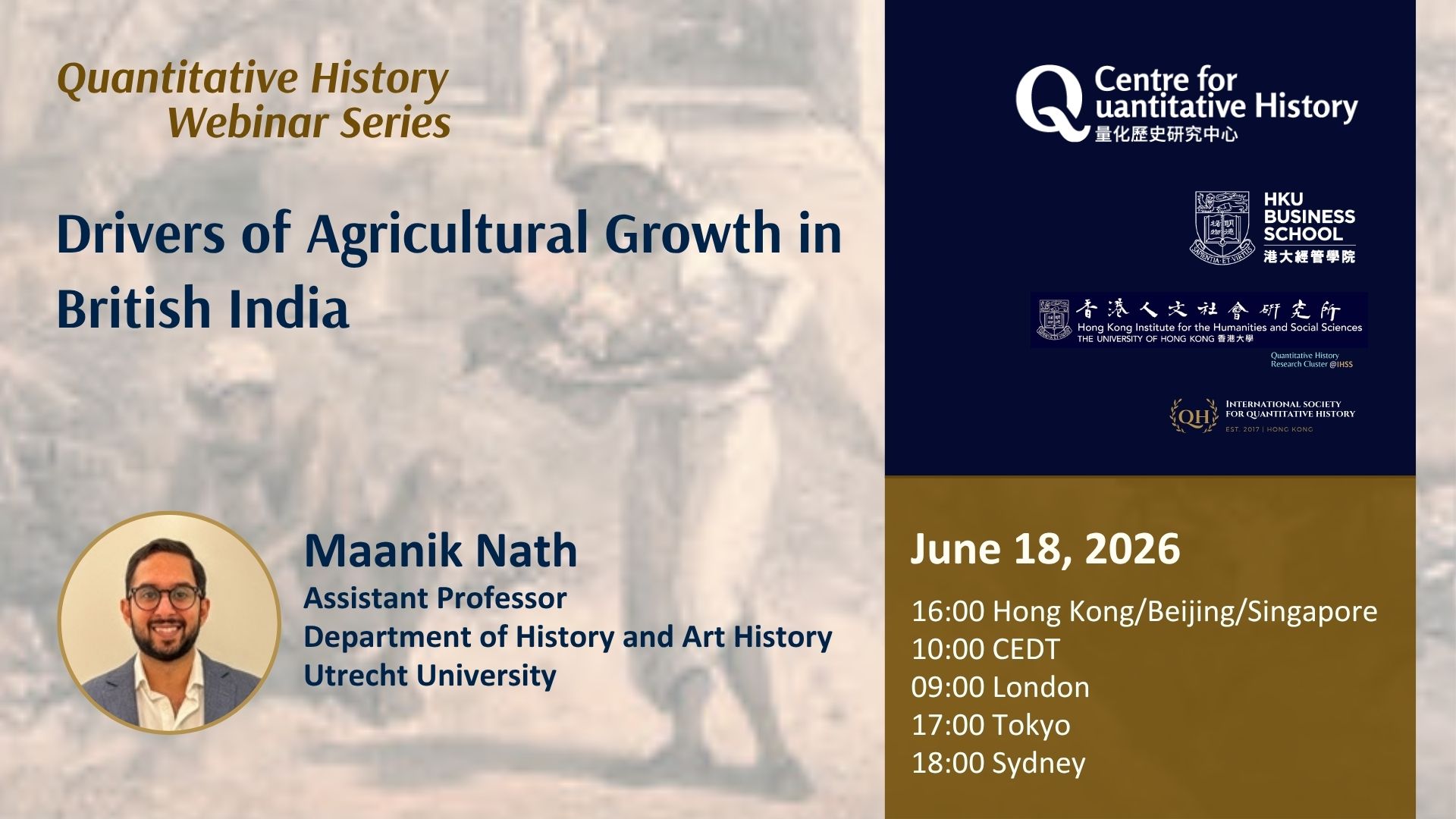
Table of Contents Description Maanik Nath of Utrecht University and his co-author investigate the impact of public investments on agricultural incomes across colonial India. Using new data in a difference-in-differences framework, it shows that districts with access to canal irrigation experienced a 22% increase in agricultural incomes, alongside a three to six percentage-point decline […]
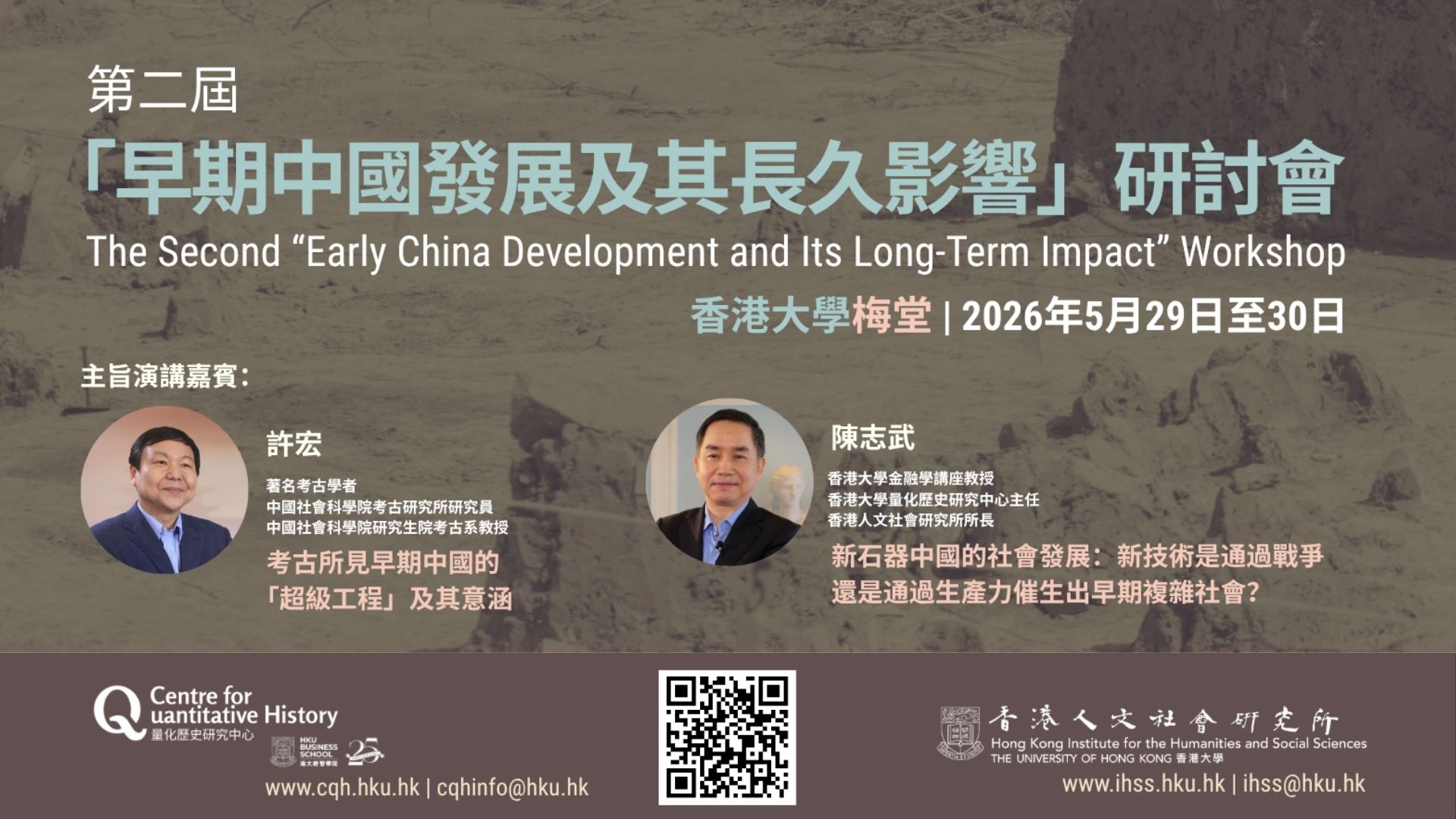
Event Highlights What can stone tools tell us about the rise of complex societies? Did iron technology strengthen states through farming, warfare or both? How might bronze inscriptions, burial goods, ancient bodies and administrative records help us understand the long-term development of China? These questions were at the centre of the Second “Early China Development […]
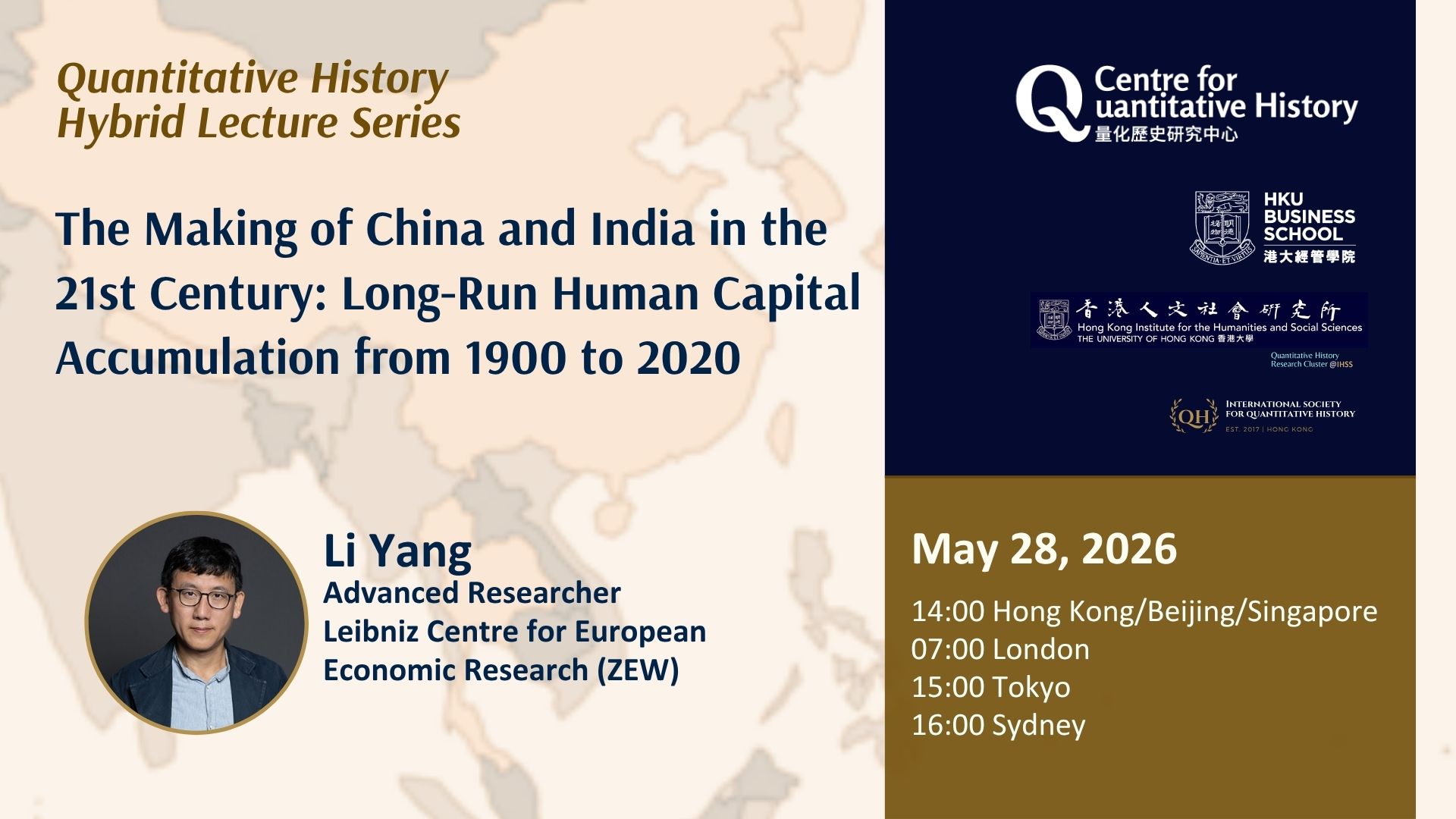
Description In this Quantitative History hybrid lecture, Li Yang of the Leibniz Centre for European Economic Research (ZEW) will present new evidence on the divergence in economic growth between China and India from the 1980s onward, focusing on how human capital accumulation evolved in each country. The talk will draw on a novel dataset covering […]
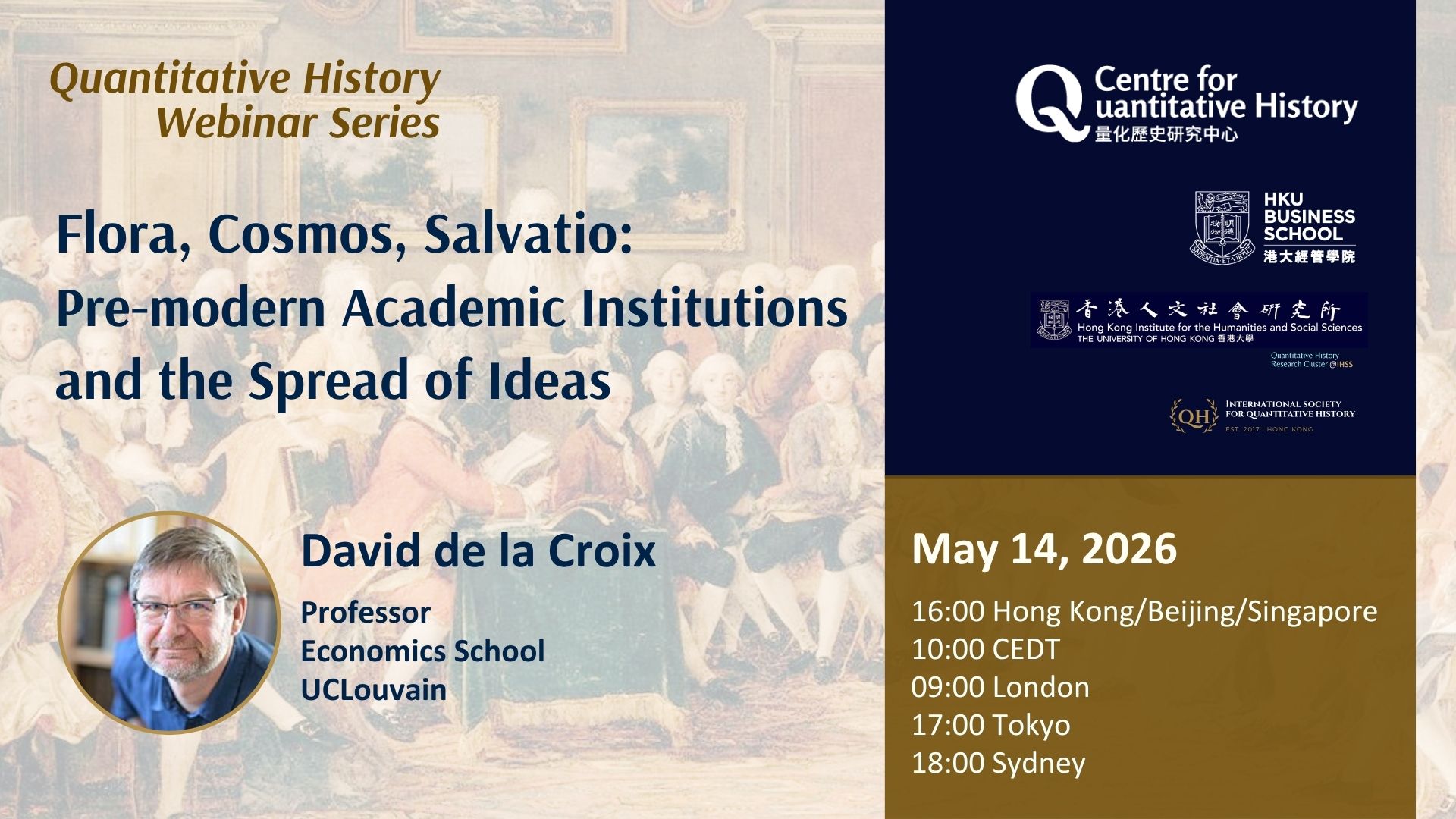
Description While good ideas can emerge anywhere, it takes a community to develop and disseminate them. In this Quantitative History webinar, David de la Croix of UCLouvain will reconstruct how interpersonal connections formed through institutional affiliations across premodern Europe (1084–1793), where roughly 200 universities and 150 academies of sciences housed thousands of scholars and produced […]
Description Plague was the most lethal disease in early modern England. However, there is limited large-scale quantitative evidence about the factors that allowed plague to spread between settlements. In this Quantitative History Webinar, Eric B. Schneider of the London School of Economics and Political Science will present a study using a novel dataset of aggregated […]
DESCRIPTION In this Quantitative History Webinar, Lukas Rosenberger of Ludwig-Maximilians-Universität Munich will introduce a new approach to understanding technological progress and economic growth during the Industrial Revolution by combining modern growth theory with detailed micro-data. Lukas and his co-authors develop a multi-sector endogenous growth model to study one leading theory of British advantage during the […]
DESCRIPTION Combining detailed data on language and migration across colonial Indian districts in 1901 with a gravity model, Professor James Fenske of the University of Warwick and his co-authors find that origin and destination districts separated by more dissimilar languages saw less migration. They control for the physical distance between origin-destination pairs, several measures of […]
The CRTA open-access database (https://crta.info/wiki/Main_Page) has, per January 2026, descriptions of nearly 6,000 editions of religious texts, mostly for the 1550-1940 period.
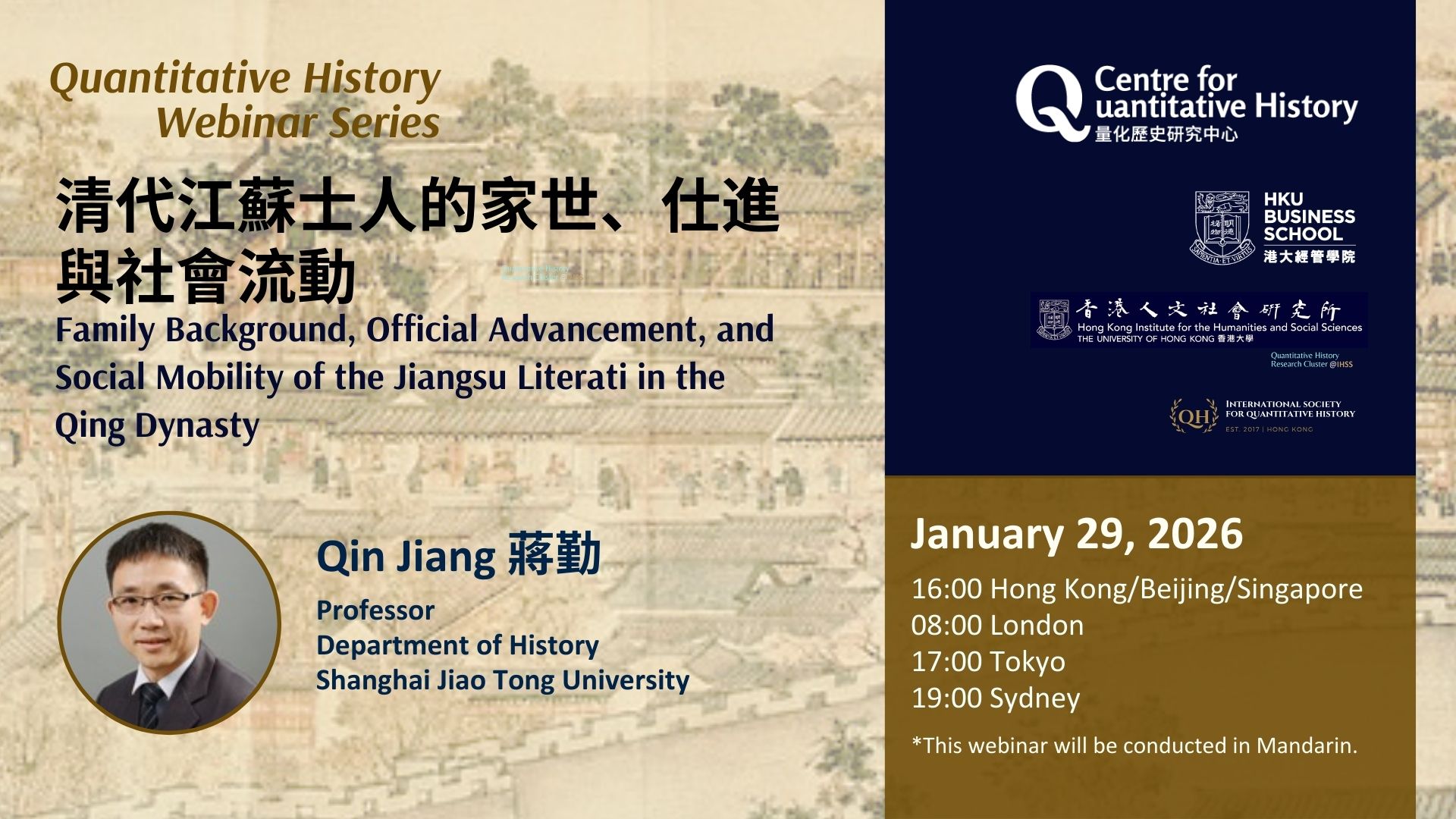
DESCRIPTION清代江蘇士人的家世、仕進與社會流動 科舉制綿延1300餘年,對傳統中國的方方面面產生了重大影響,其中科舉與社會流動的關係尤為惹人注目。 上海交通大學歷史系教授蔣勤利用量化方法研究科舉人物履歷的傳統,根據《通靜二庠題名錄》建立了清代南通和海門兩縣(學)6486名生員資料庫。 研究發現,在科場上,生員層次的社會流動性(階梯寬度)要高於舉人和進士層次,但士紳家庭的競爭優勢體現在各個層級的概率和通過時機上,晉陞階梯實際上在逐階地收窄。 在官場上,由於入仕以獲取中高級科名為前提,那些跨過科舉門檻的平民家庭士子們,在入仕率方面並不顯著低於生員、監生和士紳家庭出身者; 不過士紳家庭出身的舉人更易獲得中高級官職,且就任於州縣官等重要職位,而平民和生監家庭出身的舉人則更易就職於州縣教諭、訓導等學官。 在本次量化歷史網上講座,蔣勤將首次基於一個地區的生員總體,從科舉和仕途兩方面,提供一幅清代士人完整的科舉仕進圖,並且證明科舉確實提供了社會流動的空間,而家世影響更多體現在托舉子代通過科舉獲得更高科名,較難在入仕方面的作用提供直接説明,卻又隱蔽地起作用。 最後,講座還將簡單比較無錫、常熟兩地生員錄和南通生員錄所反映情況的異同。 Family Background, Official Advancement, and Social Mobility of the Jiangsu Literati in the Qing Dynasty The imperial examination system, which spanned over 1,300 years, exerted a profound influence on all aspects of traditional China, particularly regarding social mobility. Qin Jiang from Shanghai Jiao Tong University constructs a […]
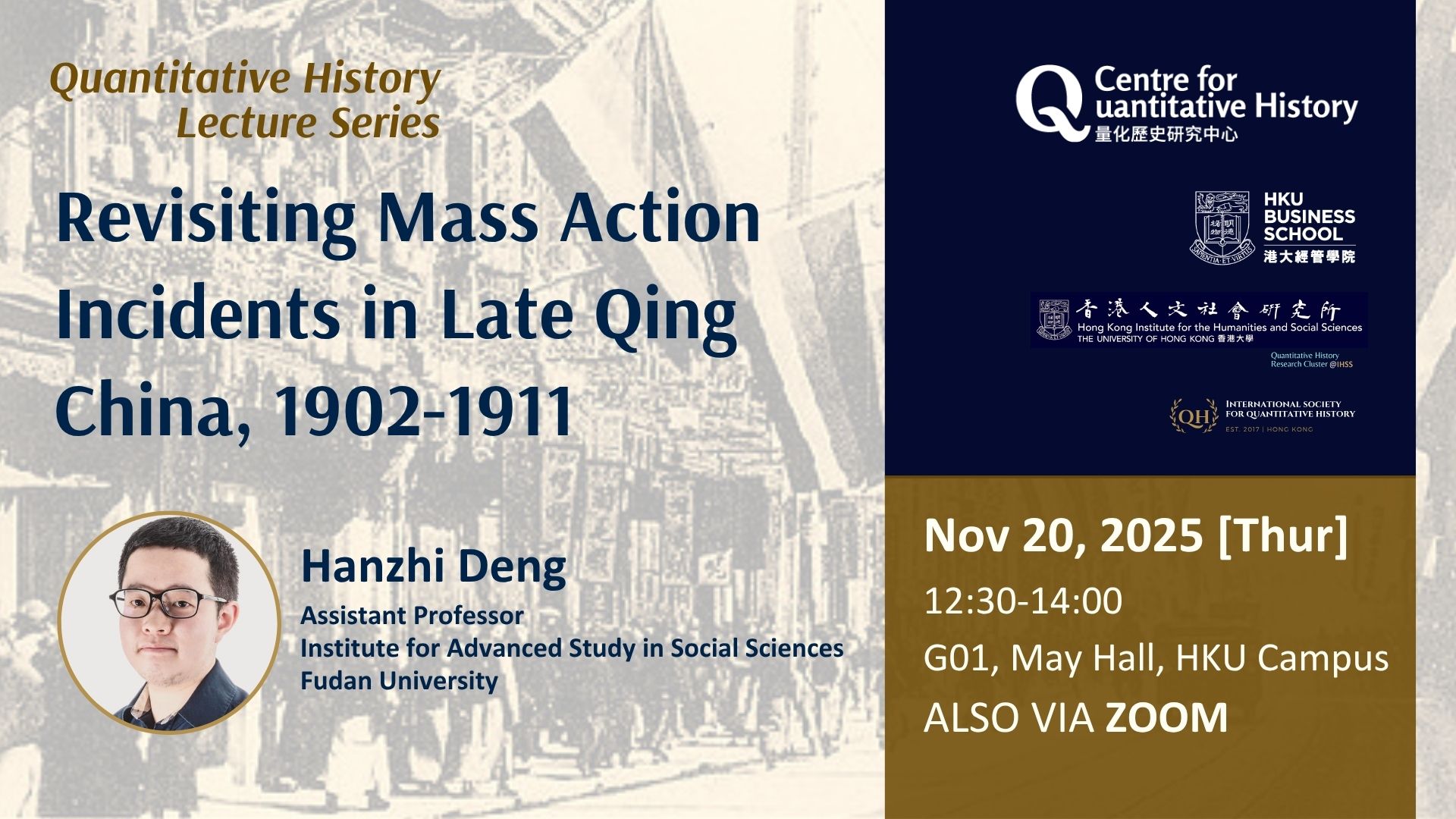
DESCRIPTIONThe Qing state launched the ‘new policy’ reform during the first decade of the 20th century. This ambitious and profound reform unexpectedly led to an increasing number of mass action incidents nationwide, ultimately bringing an end to China’s imperial regime. When assessing mass actions during this precarious decade, previous studies often connect them to the […]
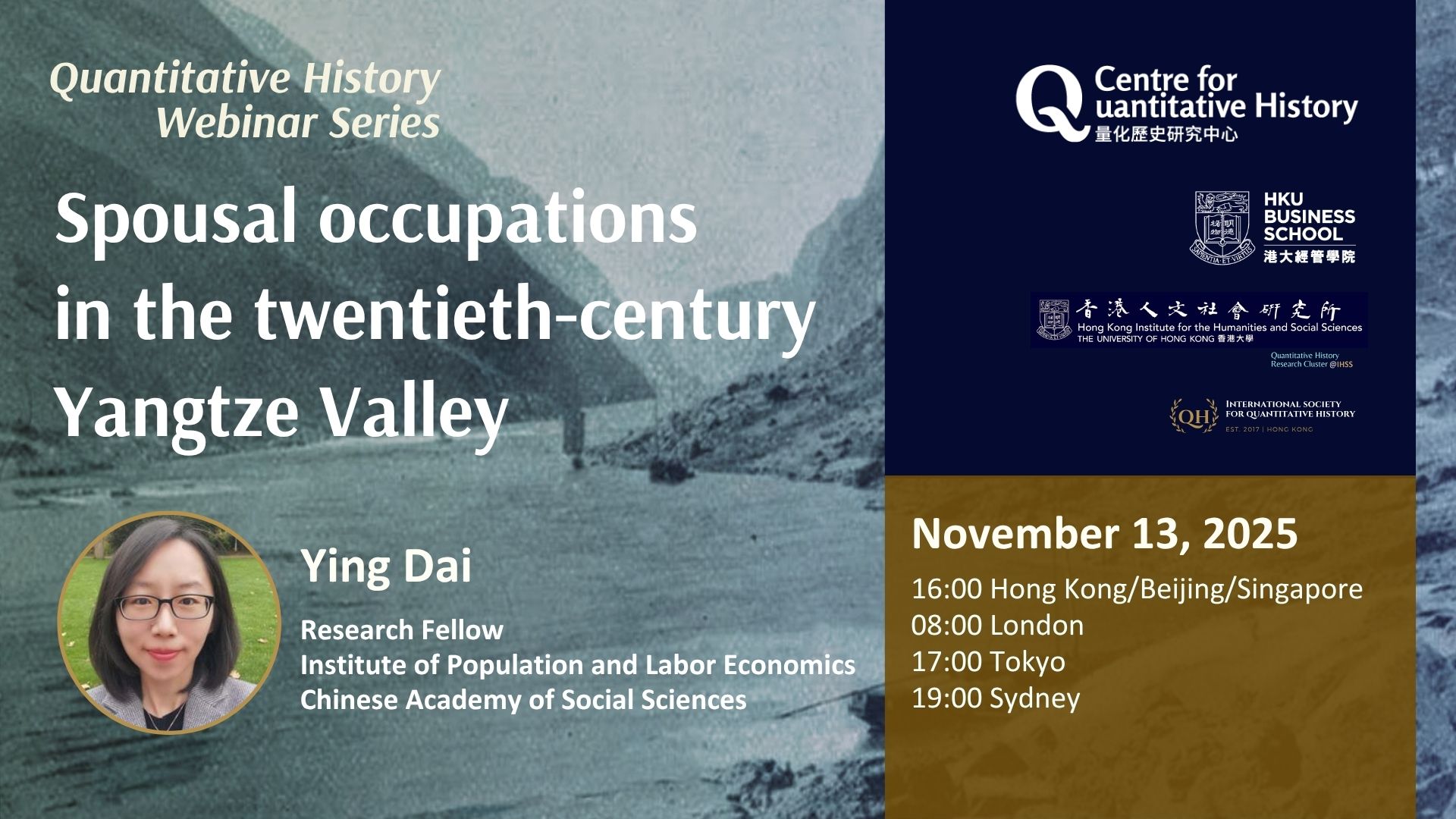
DESCRIPTIONThe husband-wife occupations significantly influence a family’s economic condition, social capital, and everyday experience. Changes in spousal occupations forms a major aspect of transformation in Chinese families over the twentieth century. Ying Dai of Chinese Academy of Social Sciences and her co-author utilise 175 lineage genealogies with 57,501 couples to examine the spousal occupations of […]
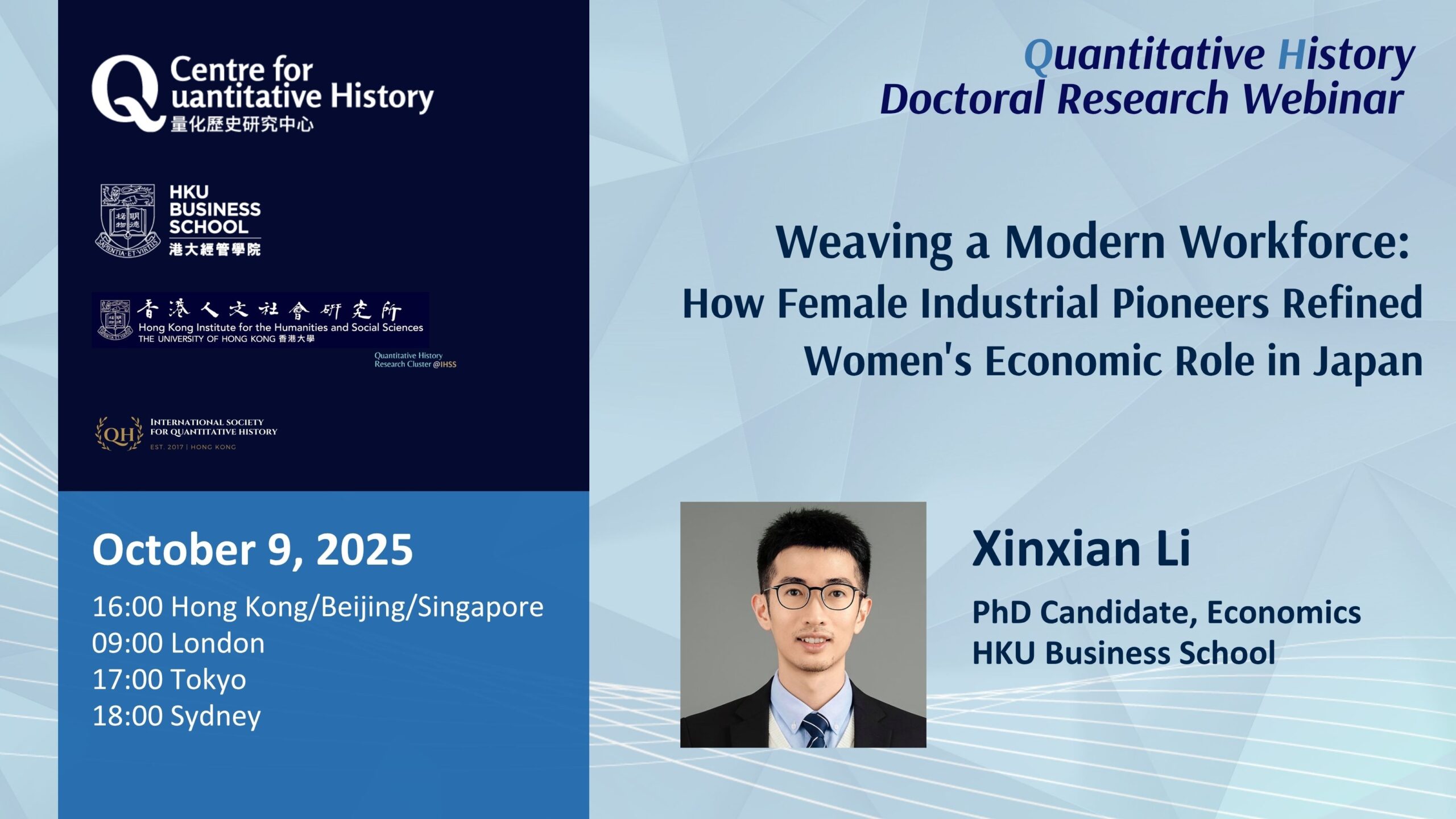
DESCRIPTIONEarly industrialization created a tension between new economic opportunities and traditional social norms that confined women to the domestic sphere. Xinxian Li, Research PhD Candidate of HKU Business School, examines how female industrial pioneers helped mediate this tension by prompting more women to participate in factory employment during the early industrialization in late 19th to […]
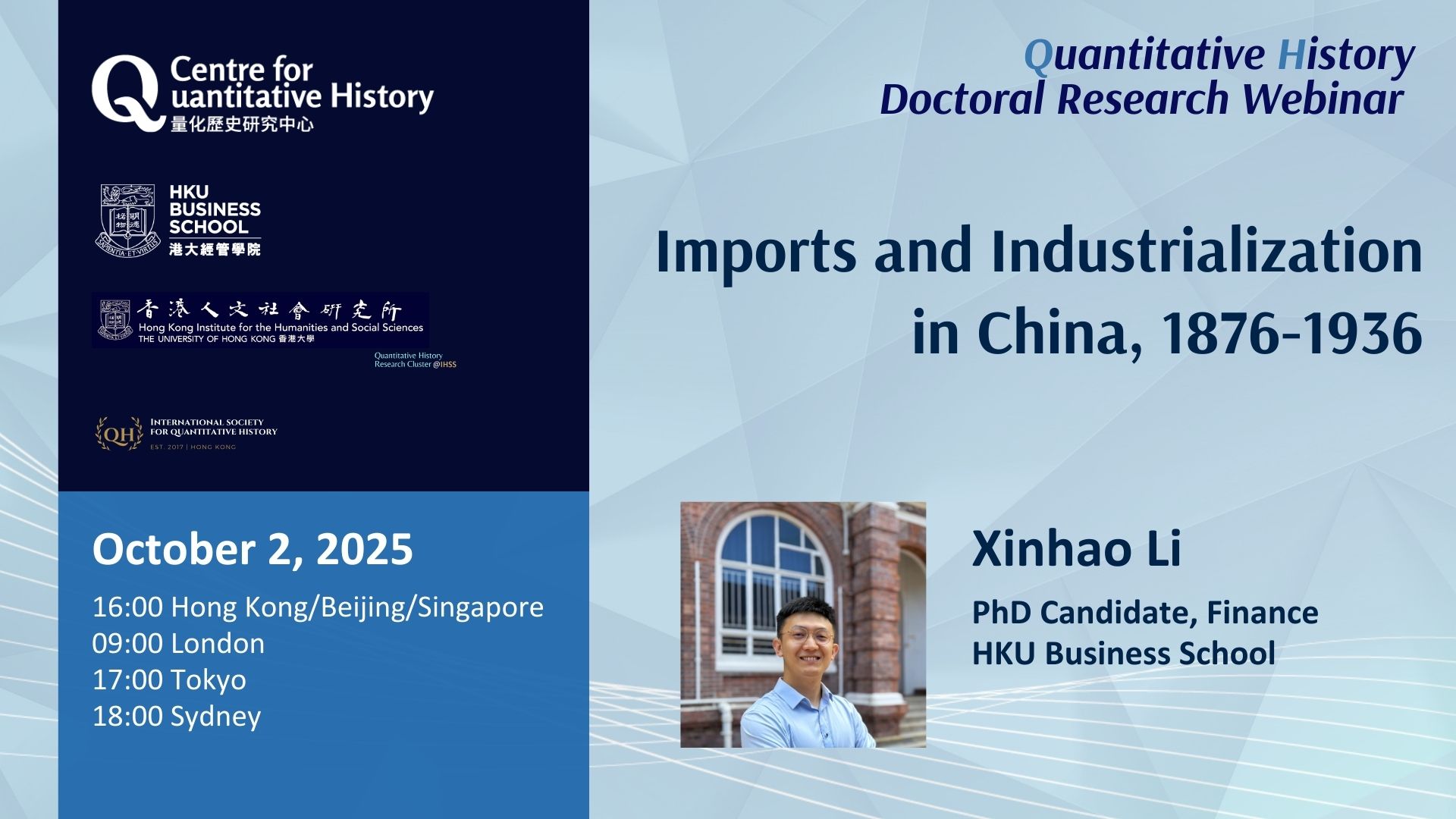
DESCRIPTIONXinhao Li, Research PhD Candidate of HKU Business School, examines the impact of import penetration in 1876-1892 on subsequent industrial development in China from 1896 to 1936. He collects import values for Chinese inland prefectures from the annual trade reports at each port of the Chinese Maritime Customs. Matching the imports with industrial establishments at […]
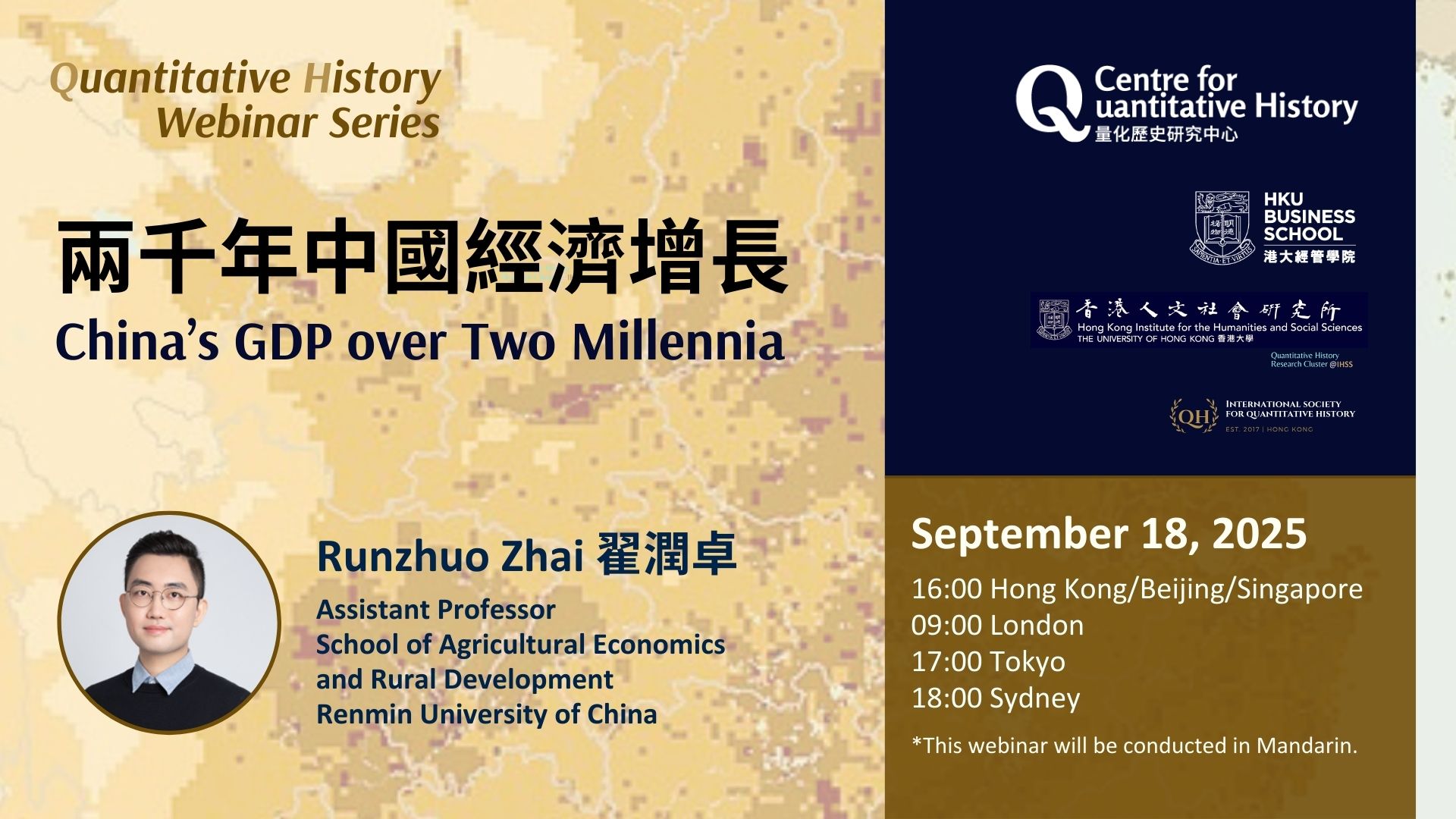
DESCRIPTION兩千年中國經濟增長中國人民大學農業與農村發展學院助理教授翟潤卓構建了從秦代到1949年連續的、十年分辨率的中國歷史GDP數據集。在兩千多年的歷史中,中國經濟增長軌跡呈現出千年尺度的準倒U型趨勢。從秦代到北宋初期,人均GDP從380國際元(1990年水平)持續增長至1949年之前的最高水平1,430國際元。自北宋以後,人均GDP則表現出長期震盪下降的趨勢,直到19世紀後期長期維持在550國際元的水平。在本次量化歷史網上講座,翟潤卓將解釋經濟增長過程的解構顯示,在兩千多年的歷史中,中國歷史經濟增長呈現出一種馬爾薩斯風格的人口驅動模式,但並不完全符合經典馬爾薩斯(Malthusian)理論中「工資鐵律」所描繪的長期停滯圖景。China’s GDP over Two MillenniaRunzhuo Zhai of Renmin University of China constructs, for the first time, a decadal GDP dataset for China from 220 BCE to 1949 CE, which, when linked to adjusted post-1949 data based on official surveys, offers a clear view of China’s economic performance over the past two millennia. The continuous series […]
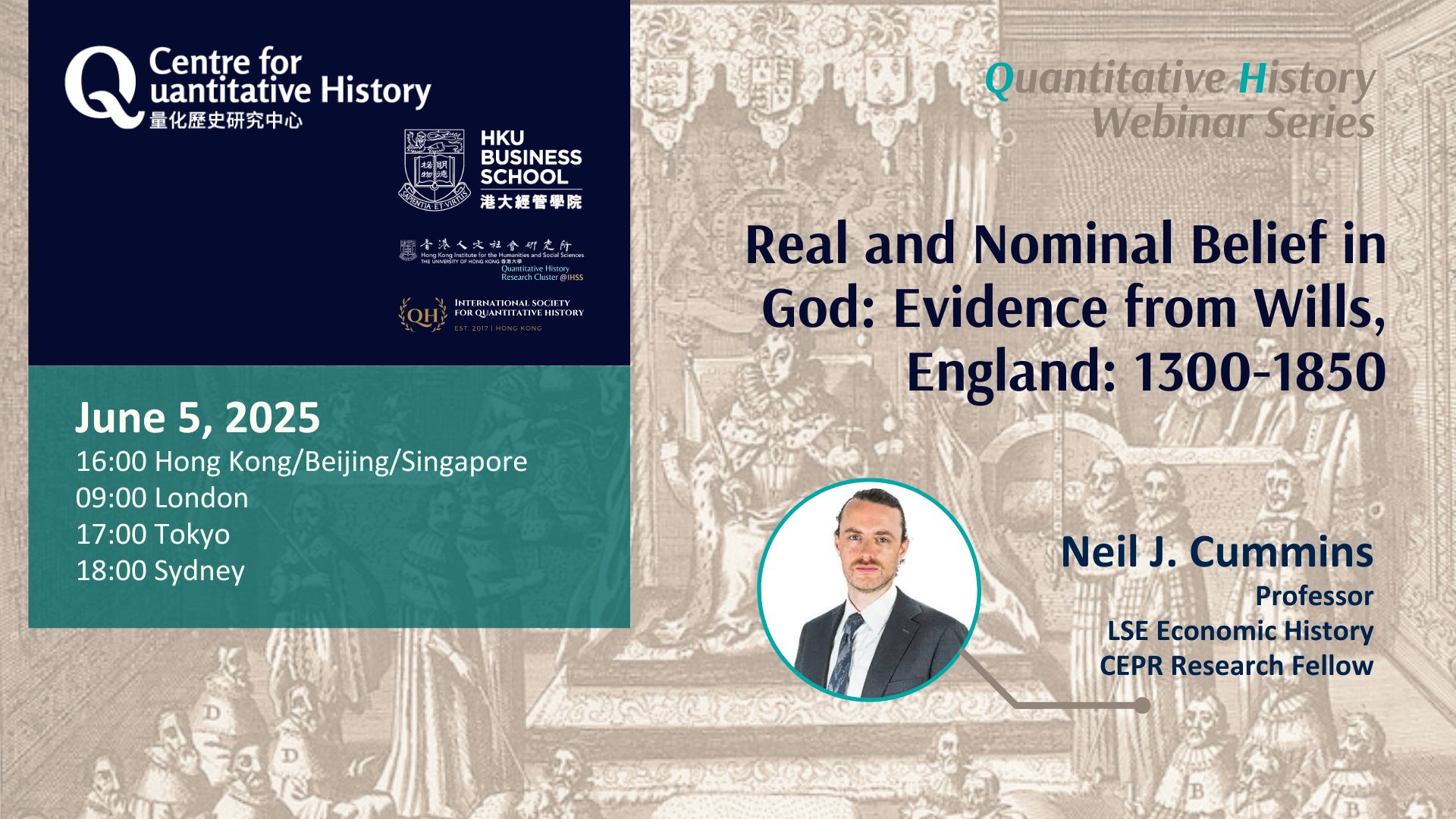
DESCRIPTIONNeil J. Cummins of LSE and his co-author use the full-texts of ~36,000 English wills to generate estimates of religiosity, 1300-1850. They distinguish between pro-forma performative statements of belief in a creator God in the preamble, which they term “nominal” religiosity, from “real” religiosity, non-template religious statements in the latter part of the will, and […]
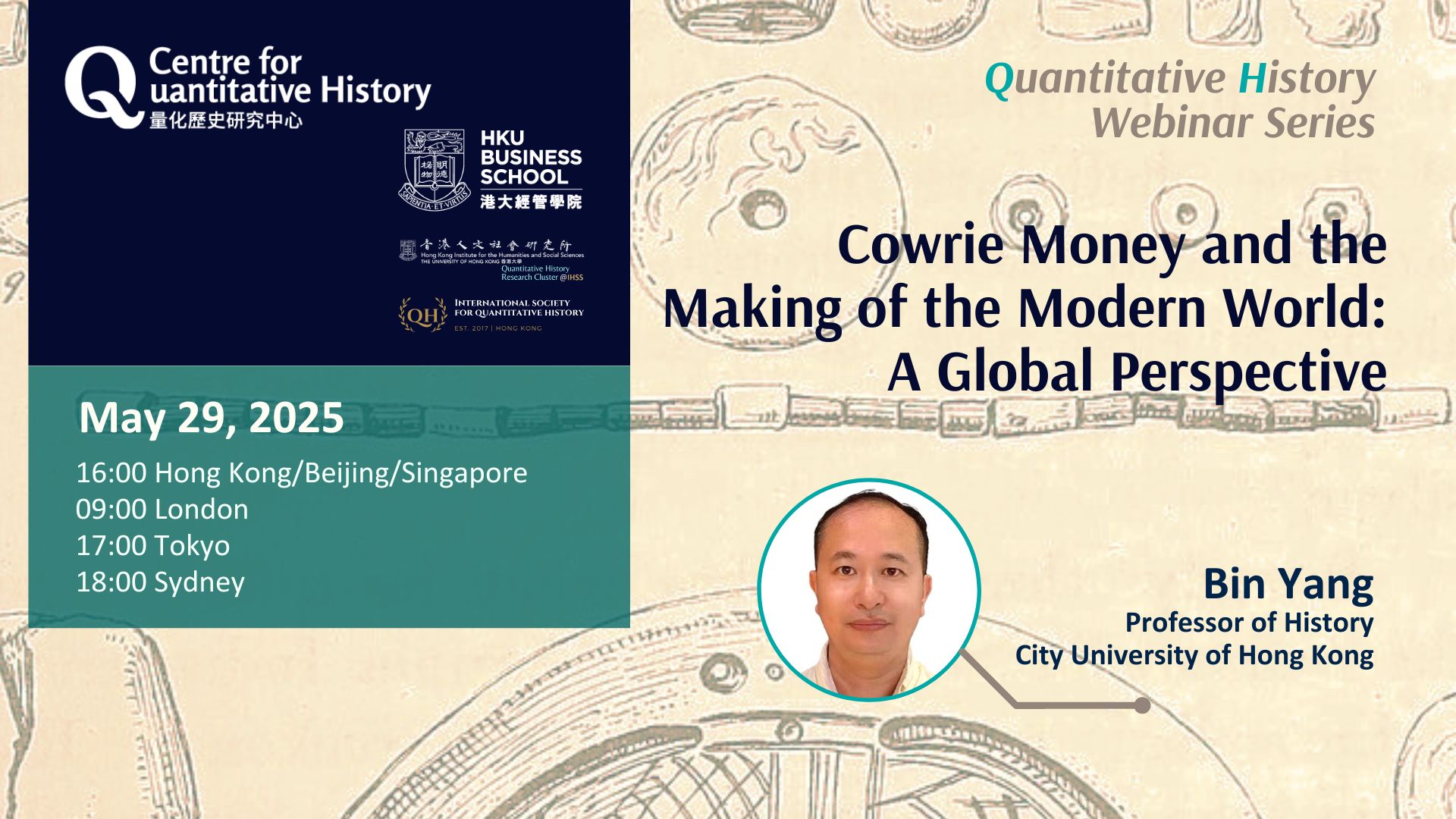
DESCRIPTIONOriginating in the sea, especially in the waters surrounding the low-lying islands of the Maldives, Cypraea moneta (sometimes confused with Cypraea annulus) was transported to various parts of Afro-Eurasia in the prehistoric era, and in many cases, it was gradually transformed into a form of money in various societies for a long span of time. During this Quantitative […]
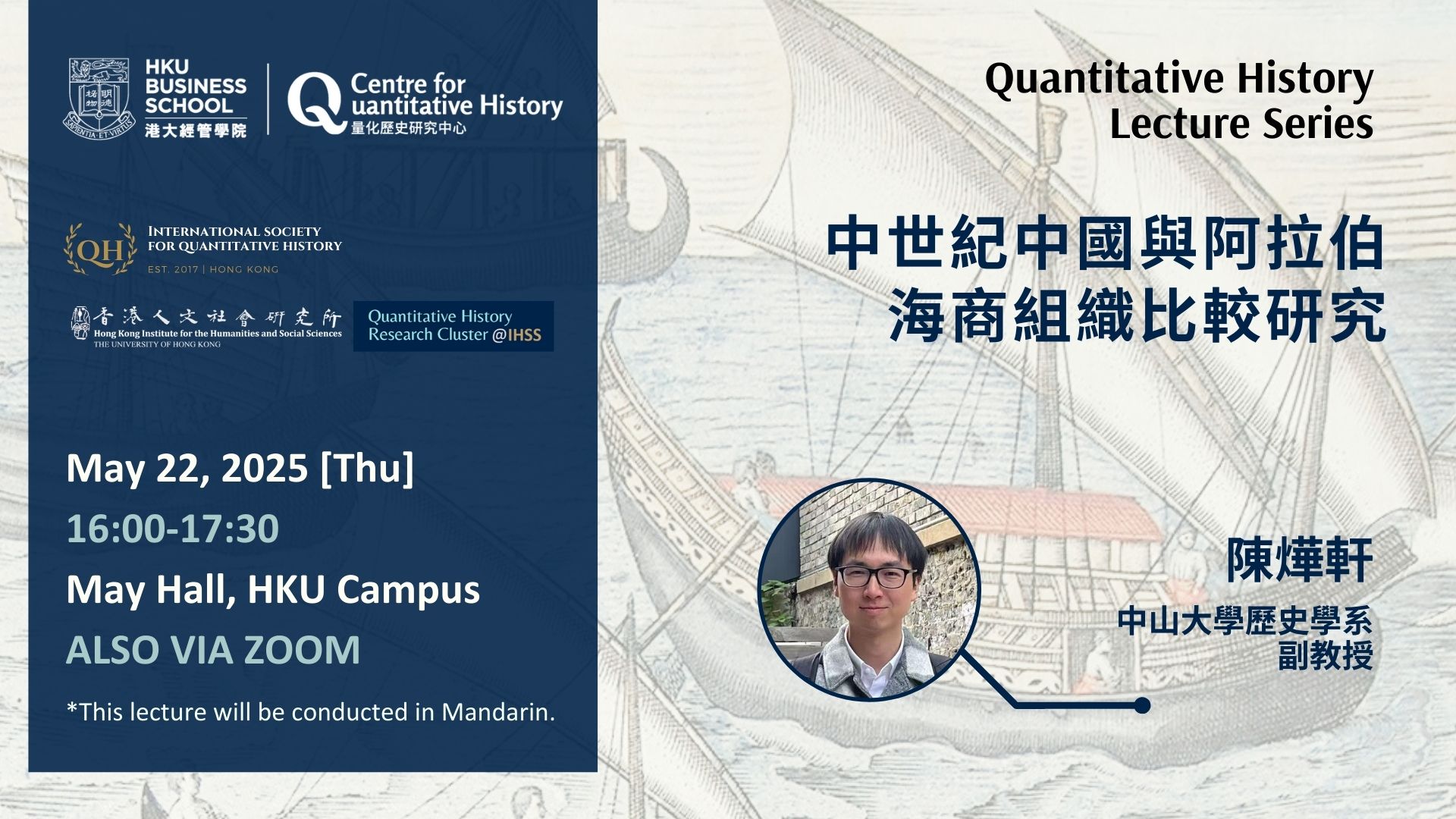
DESCRIPTIONBased on previous studies, by making use of extant literature, stele inscriptions, documents and underwater archaeological materials, Yexuan Chen reconstructs the routes of the commercial seafaring of Arab and Chinese merchants, analyzes the organization and cargo management of merchant ships, and explores the international trade patterns during the Medieval era. During this lecture, Yexuan Chen […]
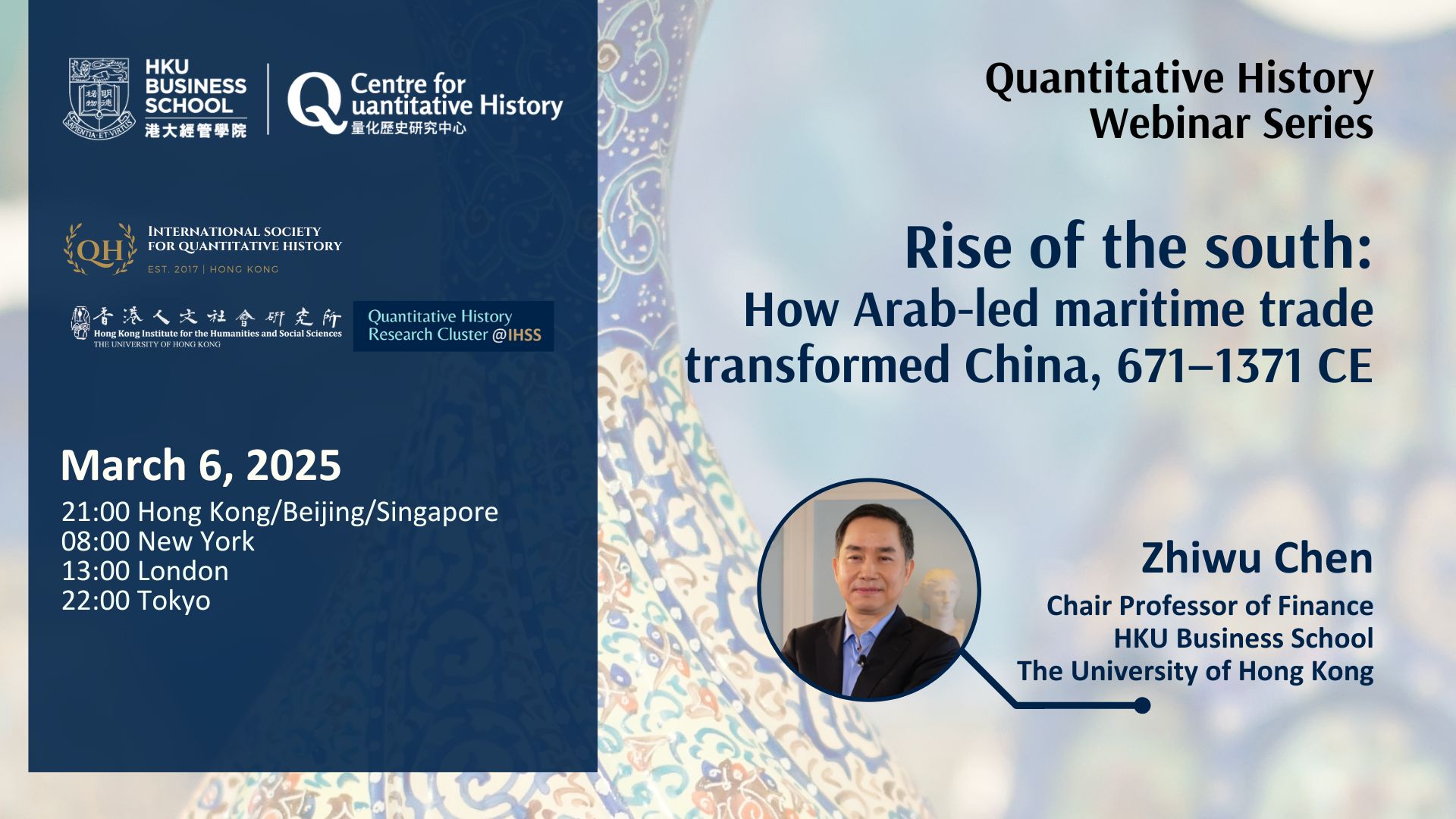
Title: Rise of the south: How Arab-led maritime trade transformed China, 671–1371 CESpeaker: Zhiwu Chen Chair of Finance Cheng Yu-Tung Professor in Finance Director, Centre for Quantitative History Director, HK Institute for Humanities and Social Sciences HKU Business SchoolDate/Time: March 6, 2025 21:00 - 22:3021:00 (Hong Kong/Beijing/Singapore) 08:00 (New York) | 05:00 (Los Angeles) | […]
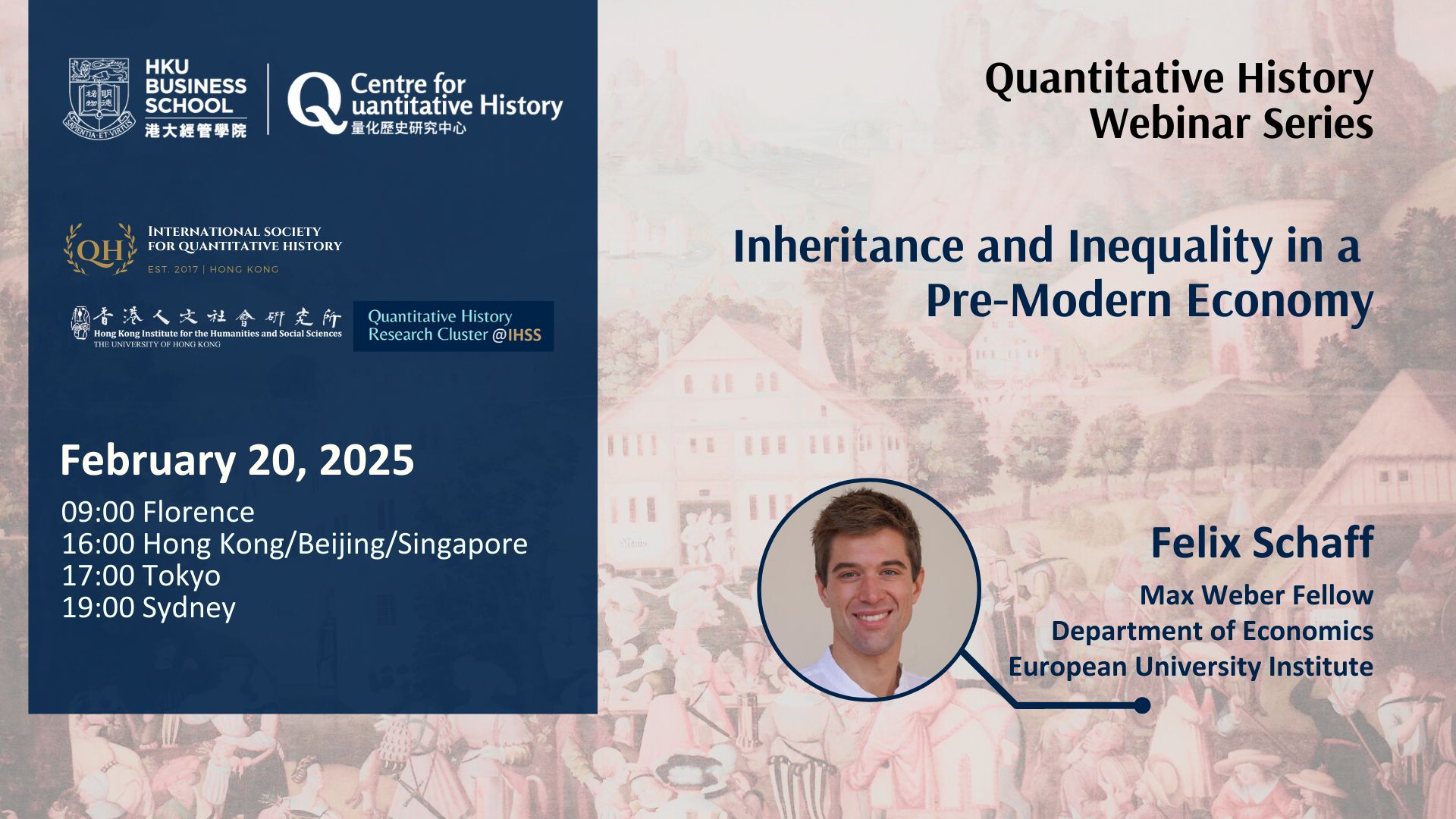
Title: Inheritance and Inequality in a Pre-Modern EconomySpeaker: Felix Schaff (Max Weber Fellow, Department of Economics, European University Institute)Date/Time: February 20, 2025 16:00 - 17:3009:00 Florence | 16:00 (Hong Kong/Beijing/Singapore) | 03:00 (New York) | 00:00 (Los Angeles) | 08:00 (London) | 17:00 (Tokyo) | 19:00 (Sydney)Venue: Via ZoomLanguage: EnglishEnquiry: cqhmail@hku.hkRegister Now: https://hku.zoom.us/webinar/register/5817326069296/WN_269qJz9qRKu7fVOD6dl1pg#/registrationDescription How do inheritance […]