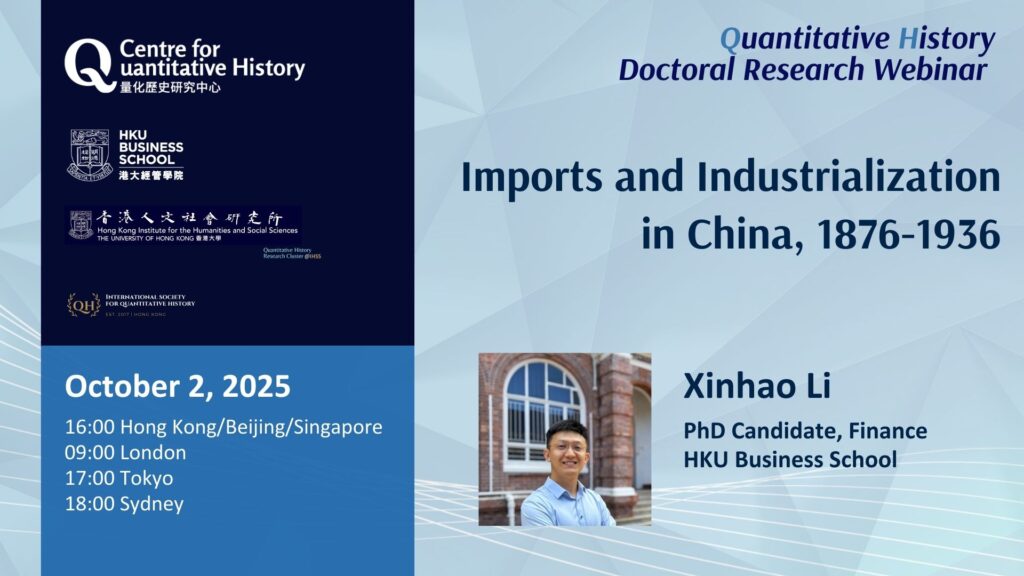
Xinhao Li, Research PhD Candidate of HKU Business School, examines the impact of import penetration in 1876-1892 on subsequent industrial development in China from 1896 to 1936. He collects import values for Chinese inland prefectures from the annual trade reports at each port of the Chinese Maritime Customs. Matching the imports with industrial establishments at the prefecture level, he finds that prefectures with greater import values had more industrial firms established thereafter. For causal identification, he exploits the role of the silver-copper exchange ratio in shifting the relative price of foreign goods in the domestic market and construct a shift-share-like instrument for the import distribution. Through decomposing the imports by sectors, he finds that high-tech manufactures are more beneficial to industrial development relative to low-tech ones. The high-tech manufacturers were also associated with a higher level of public interest in manufacturing and scientific knowledge. During this Quantitative History Doctoral Research Webinar, he will further provide evidence that import trade facilitated China’s industrialization by empowering Chinese business elites as pioneering industrialists.