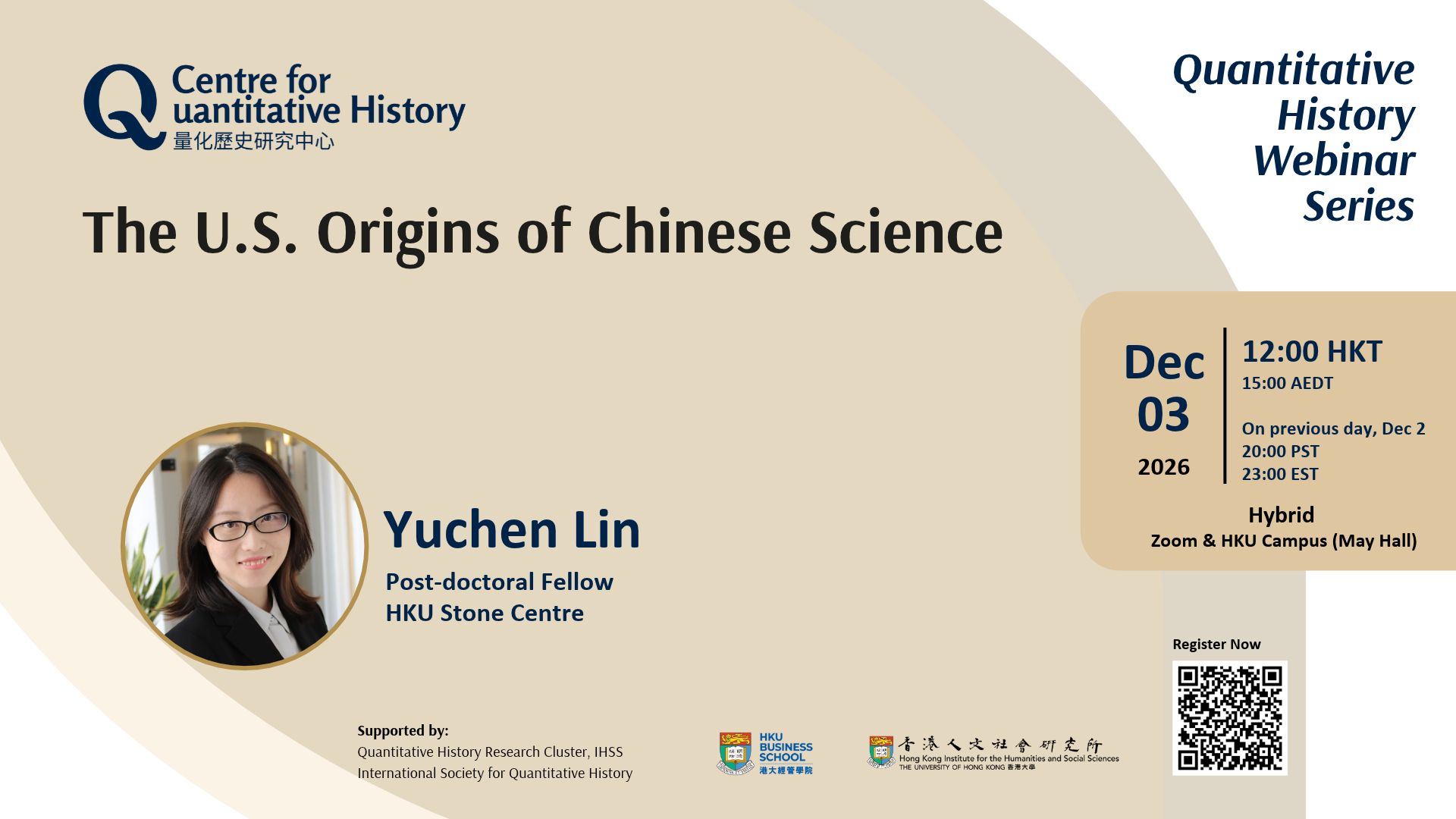
The U.S. Origins of Chinese Science
Lecture Hall, G/F, May Hall, The University of Hong Kong, or Via Zoom , Hong KongIn this Quantitative History Webinar, Yuchen Lin of HKU Stone Centre will present research on the persistence of scientific connections despite political disruptions. She examines how institutional connections in physics between Chinese and U.S. universities, established before the Communist Revolution in 1949, survived two decades of restricted communication and contributed to China’s scientific development after its opening in 1978. Yuchen’s study compiles a novel dataset of biographies of U.S.-educated Chinese physicists and measures historical connections between Chinese and U.S. university pairs by linking physicists’ 1978 affiliations to their pre-1949 institutions in the counterpart country. Leveraging the exogenous reallocation of faculty during China’s 1952 higher education reform, it finds that historical academic connections increased flows of Chinese graduate students to the United States and increased similarity in publication topics and patent fields at the university-pair level. Yuchen documents three mechanisms: reduced information frictions in student decisions, increased cross-border scientific collaboration, and increased awareness of U.S. frontier research. Ice-breaking visits by U.S. scientists to China in the mid-1970s further amplified these effects, demonstrating that dormant connections can be reactivated. The paper thus highlights the persistence of social networks despite prolonged interruptions in interaction.