Filters

Changing any of the form inputs will cause the list of events to refresh with the filtered results.

The U.S. Origins of Chinese Science

Lecture Hall, G/F, May Hall, The University of Hong Kong, or Via Zoom , Hong Kong

In this Quantitative History Webinar, Yuchen Lin of HKU Stone Centre will present research on the persistence of scientific connections despite political disruptions. She examines how institutional connections in physics between Chinese and U.S. universities, established before the Communist Revolution in 1949, survived two decades of restricted communication and contributed to China’s scientific development after its opening in 1978. Yuchen’s study compiles a novel dataset of biographies of U.S.-educated Chinese physicists and measures historical connections between Chinese and U.S. university pairs by linking physicists’ 1978 affiliations to their pre-1949 institutions in the counterpart country. Leveraging the exogenous reallocation of faculty during China’s 1952 higher education reform, it finds that historical academic connections increased flows of Chinese graduate students to the United States and increased similarity in publication topics and patent fields at the university-pair level. Yuchen documents three mechanisms: reduced information frictions in student decisions, increased cross-border scientific collaboration, and increased awareness of U.S. frontier research. Ice-breaking visits by U.S. scientists to China in the mid-1970s further amplified these effects, demonstrating that dormant connections can be reactivated. The paper thus highlights the persistence of social networks despite prolonged interruptions in interaction.
The Climatic Origins of Risk-Taking: Evidence from China

Lecture Hall, G/F, May Hall, The University of Hong Kong, or Via Zoom , Hong Kong

Does climate history shape risk-taking? In this Quantitative History Webinar, Pei Gao of the National University of Singapore will present research on how climate history shapes risk-taking. Using paleoclimatic reconstructions, she measures climate variability across Chinese prefectures from 1500 to 1950 and link it to behavior today and in history. Today, people from regions with a more variable climate history behave more cautiously when uncertainty rises: investors trade less and tilt toward safer stocks, and households cut financial debt, save more, and avoid entrepreneurship. This cultural trait travels with people: among migrants, the climate history of the birth region matters even when that of the current residence is held fixed.

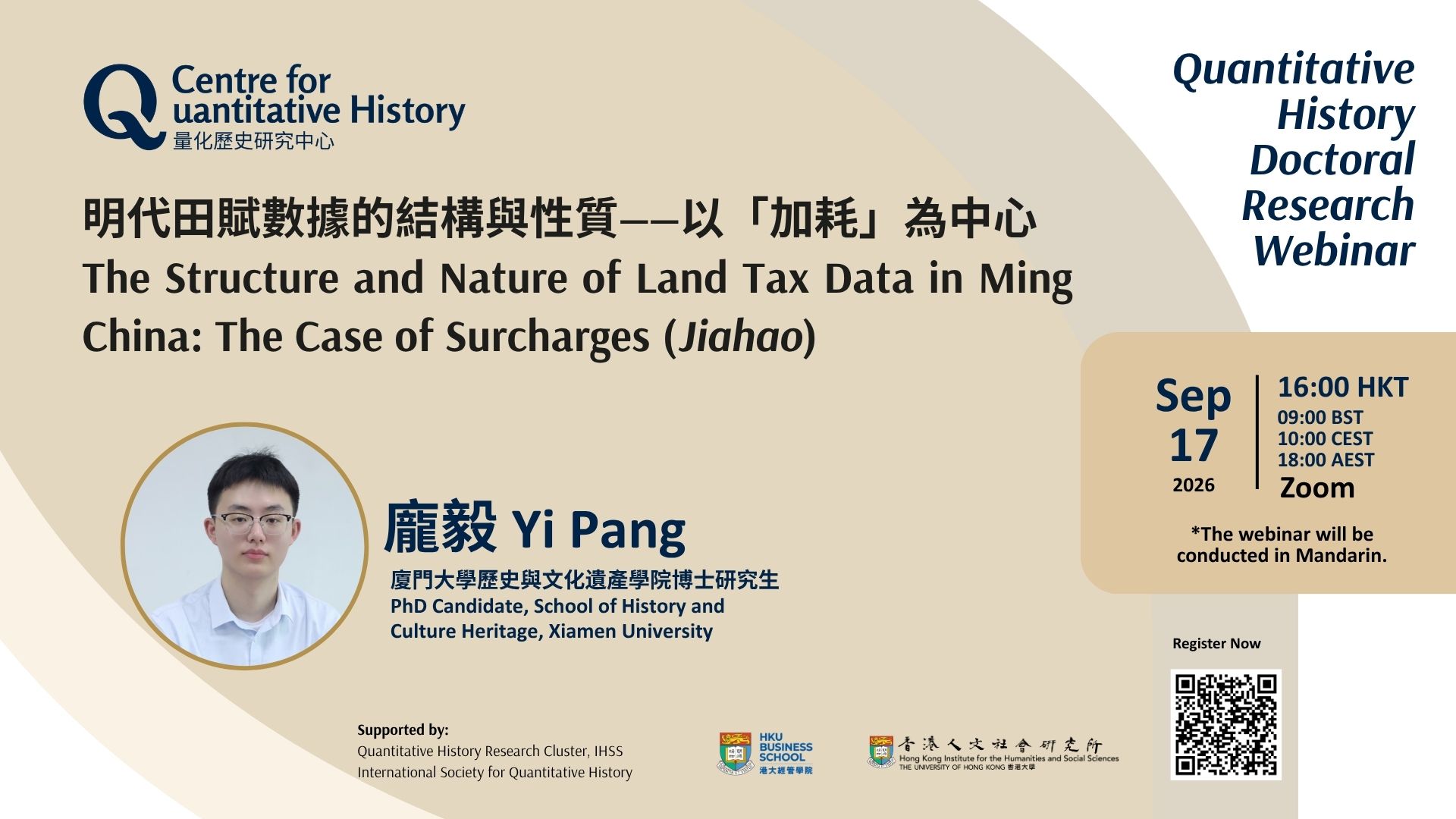
Doctoral Research Webinar | 明代田賦數據的結構與性質——以「加耗」為中心 The Structure and Nature of Land Tax Data in Ming China: The Case of Surcharges

Via Zoom

Table of Contents   Description 明代田賦數據的結構與性質——以「加耗」為中心 明代田賦數據普遍存在結構性缺失,這在「加耗」這一問題上得以集中體現。 加耗的遺漏,導致明代田賦數據難以反映真實稅制全貌。 這些不完整數據的背後,其實是中央與地方財政會計視角的根本差異,中央政府只關注入庫淨額的「歲入」,而地方政府需負擔包括加耗在內的全部「稅負」。 廈門大學歷史與文化遺產學院博士研究生龐毅通過計算加耗率,更清晰地闡述明代田賦數據的結構與性質,以及恢復地方政府的實際稅額。 The Structure and Nature of Land Tax Data in Ming China: The Case of Surcharges (Jiahao) Ming land tax data […]

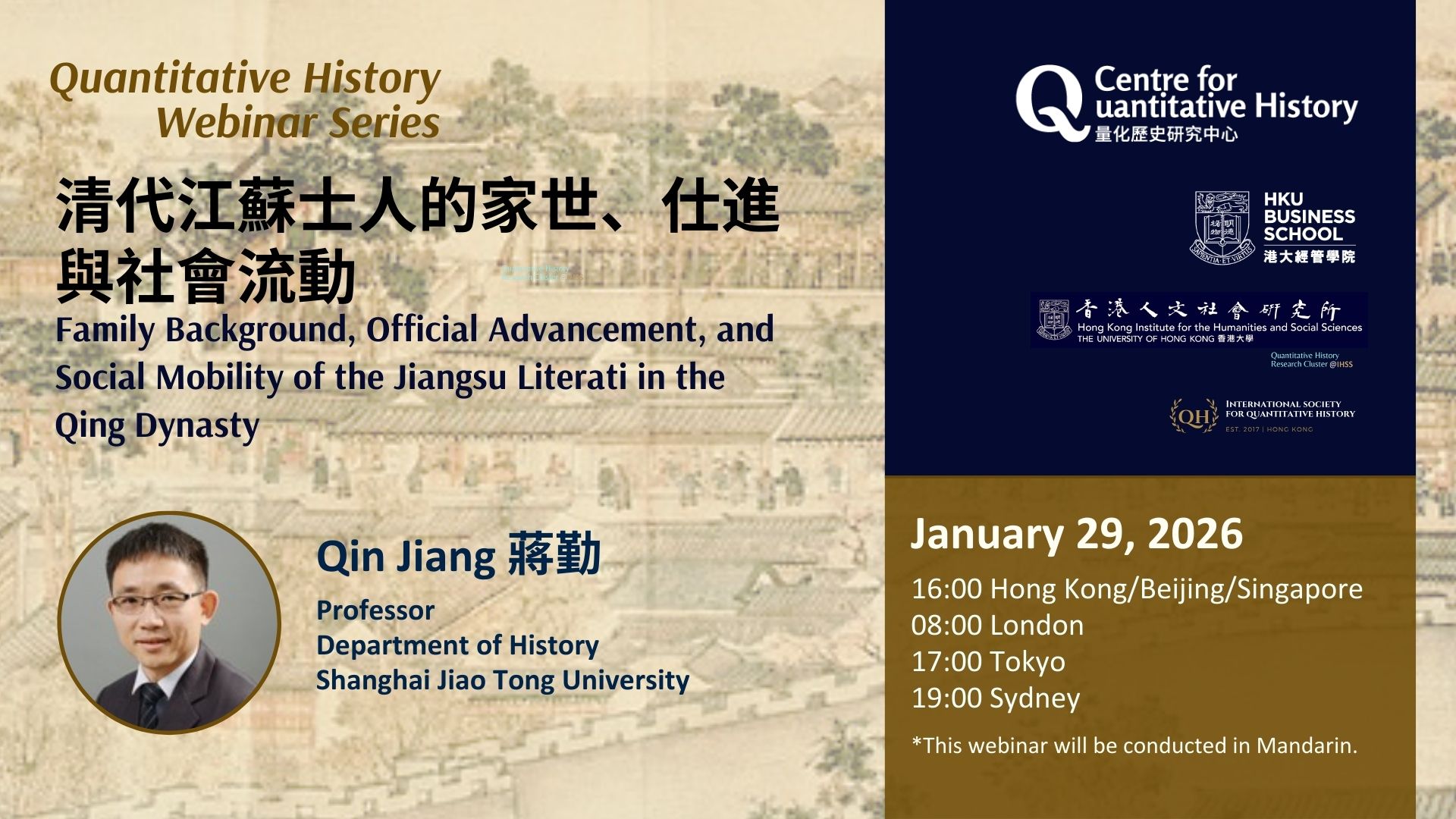
清代江蘇士人的家世、仕進與社會流動 Family Background, Official Advancement, and Social Mobility of the Jiangsu Literati in the Qing Dynasty

Via Zoom

DESCRIPTION清代江蘇士人的家世、仕進與社會流動 科舉制綿延1300餘年,對傳統中國的方方面面產生了重大影響,其中科舉與社會流動的關係尤為惹人注目。 上海交通大學歷史系教授蔣勤利用量化方法研究科舉人物履歷的傳統,根據《通靜二庠題名錄》建立了清代南通和海門兩縣(學)6486名生員資料庫。 研究發現,在科場上,生員層次的社會流動性(階梯寬度)要高於舉人和進士層次,但士紳家庭的競爭優勢體現在各個層級的概率和通過時機上,晉陞階梯實際上在逐階地收窄。 在官場上,由於入仕以獲取中高級科名為前提,那些跨過科舉門檻的平民家庭士子們,在入仕率方面並不顯著低於生員、監生和士紳家庭出身者; 不過士紳家庭出身的舉人更易獲得中高級官職,且就任於州縣官等重要職位,而平民和生監家庭出身的舉人則更易就職於州縣教諭、訓導等學官。 在本次量化歷史網上講座,蔣勤將首次基於一個地區的生員總體,從科舉和仕途兩方面,提供一幅清代士人完整的科舉仕進圖,並且證明科舉確實提供了社會流動的空間,而家世影響更多體現在托舉子代通過科舉獲得更高科名,較難在入仕方面的作用提供直接説明,卻又隱蔽地起作用。 最後,講座還將簡單比較無錫、常熟兩地生員錄和南通生員錄所反映情況的異同。 Family Background, Official Advancement, and Social Mobility of the Jiangsu Literati in the Qing Dynasty The imperial examination system, which spanned over […]

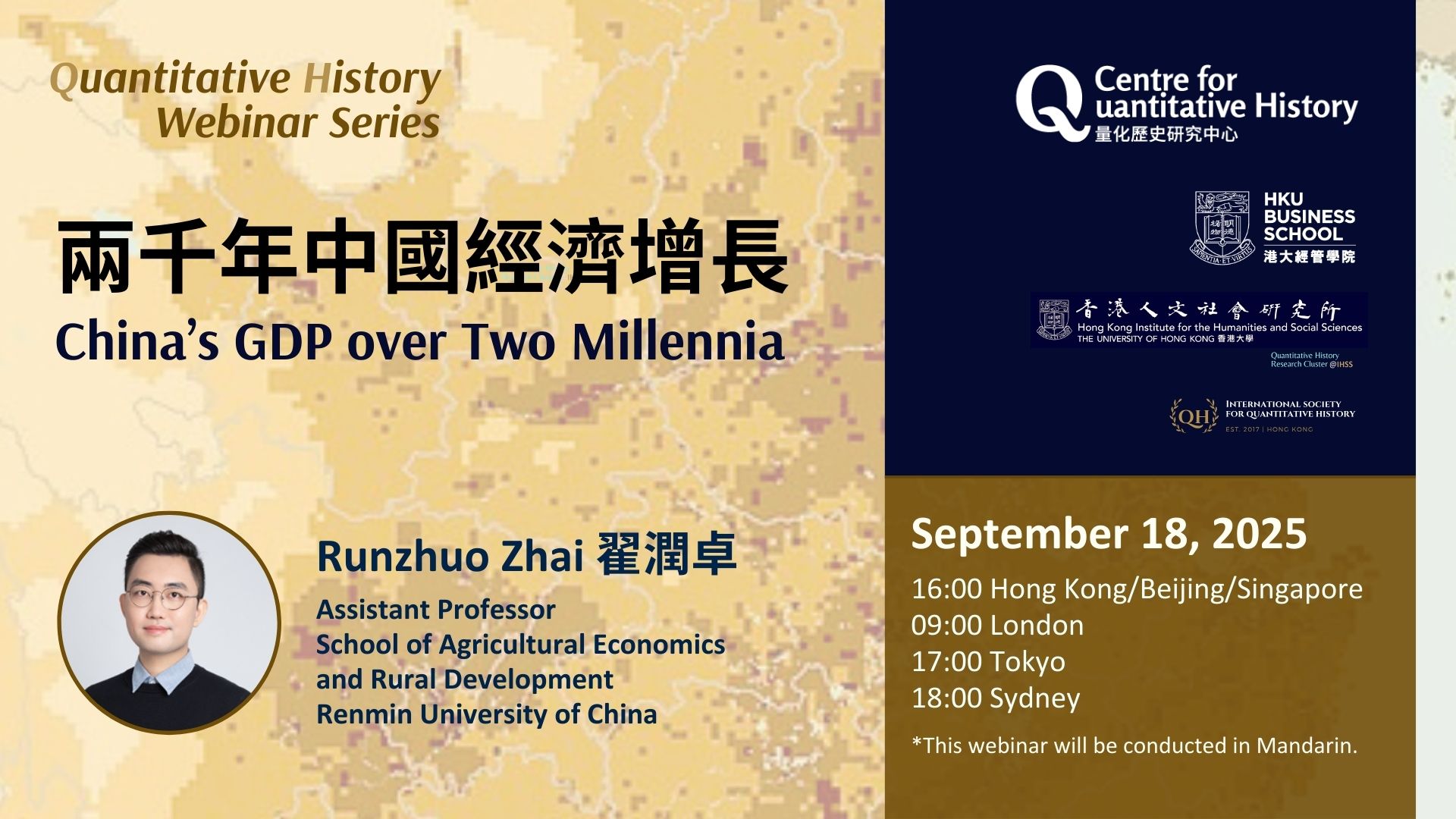
兩千年中國經濟增長 China’s GDP over Two Millennia

Via Zoom

DESCRIPTION兩千年中國經濟增長中國人民大學農業與農村發展學院助理教授翟潤卓構建了從秦代到1949年連續的、十年分辨率的中國歷史GDP數據集。在兩千多年的歷史中,中國經濟增長軌跡呈現出千年尺度的準倒U型趨勢。從秦代到北宋初期,人均GDP從380國際元(1990年水平)持續增長至1949年之前的最高水平1,430國際元。自北宋以後,人均GDP則表現出長期震盪下降的趨勢,直到19世紀後期長期維持在550國際元的水平。在本次量化歷史網上講座,翟潤卓將解釋經濟增長過程的解構顯示,在兩千多年的歷史中,中國歷史經濟增長呈現出一種馬爾薩斯風格的人口驅動模式,但並不完全符合經典馬爾薩斯(Malthusian)理論中「工資鐵律」所描繪的長期停滯圖景。China’s GDP over Two MillenniaRunzhuo Zhai of Renmin University of China constructs, for the first time, a decadal GDP dataset for China from 220 BCE to 1949 CE, which, when […]

Rise of the south: How Arab-led maritime trade transformed China, 671–1371 CE

Via Zoom

Title: Rise of the south: How Arab-led maritime trade transformed China, 671–1371 CESpeaker: Zhiwu Chen               Chair of Finance               Cheng Yu-Tung Professor in Finance               Director, Centre for Quantitative History               Director, HK […]