- Language: English
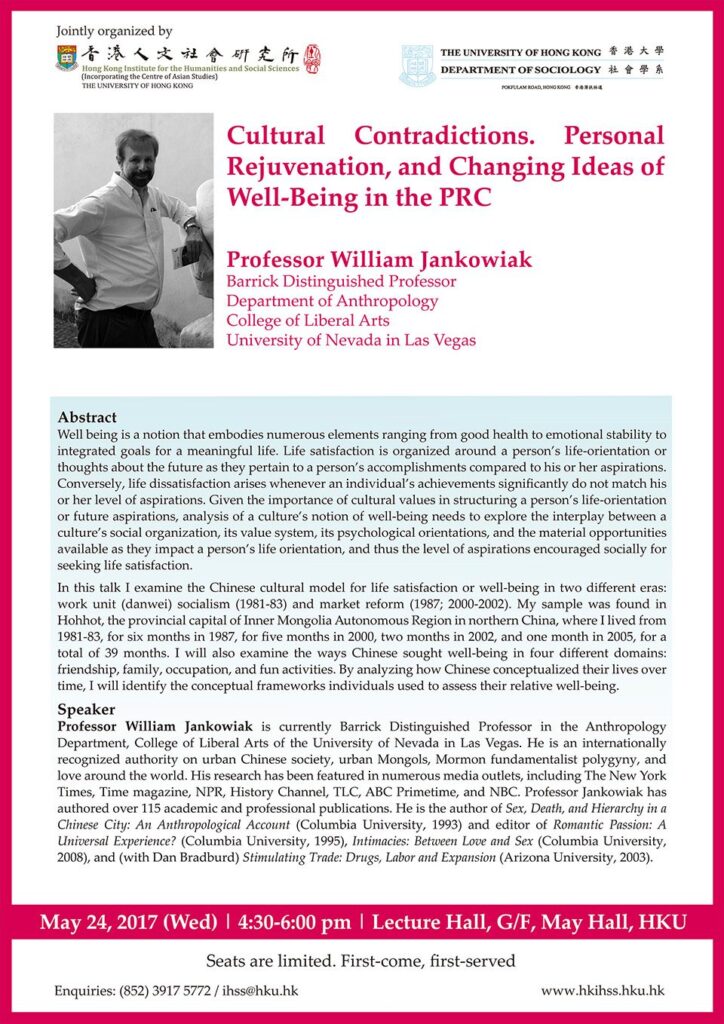
- Lecture Hall, G/F, May Hall, The University of Hong Kong
- May 24, 2017 4:30 pm – 6:00 pm
- (Tel) (852) 3917-5772
- Enquiry: ihss@hku.hk
ABSTRACT
Well being is a notion that embodies numerous elements ranging from good health to emotional stability to integrated goals for a meaningful life. Life satisfaction is organized around a person’s life-orientation or thoughts about the future as they pertain to a person’s accomplishments compared to his or her aspirations. Conversely, life dissatisfaction arises whenever an individual’s achievements significantly do not match his or her level of aspirations. Given the importance of cultural values in structuring a person’s life-orientation or future aspirations, analysis of a culture’s notion of well-being needs to explore the interplay between a culture’s social organization, its value system, its psychological orientations, and the material opportunities available as they impact a person’s life orientation, and thus the level of aspirations encouraged socially for seeking life satisfaction.
In this talk I examine the Chinese cultural model for life satisfaction or well-being in two different eras: work unit (danwei) socialism (1981 – 83) and market reform (1987; 2000 – 2002). My sample was found in Hohhot, the provincial capital of Inner Mongolia Autonomous Region in northern China, where I lived from 1981 – 83, for six months in 1987, for five months in 2000, two months in 2002, and one month in 2005, for a total of 39 months. I will also examine the ways Chinese sought well-being in four different domains: friendship, family, occupation, and fun activities. By analyzing how Chinese conceptualized their lives over time, I will identify the conceptual frameworks individuals used to assess their relative well-being.
ABOUT THE SPEAKER
Professor William Jankowiak is an internationally recognized authority on urban Chinese society, urban Mongols, Mormon fundamentalist polygyny, and love around the world. Professor Jankowiak is often invited to present the results of his research as well called on by media to provide background information on various topics. His research has been features in numerous media outlets, including The New York Times, Time magazine, NPR, History Channel, TLC, ABC Primetime, and NBC.
Professor Jankowiak has authored over 115 academic and professional publications. He is the author of Sex, Death, and Hierarchy in a Chinese City: An Anthropological Account (Columbia University, 1993) and editor of Romantic Passion: A Universal Experience? (Columbia University, 1995), Intimacies: Between Love and Sex (Columbia University, 2008), and (with Dan Bradburd) Stimulating Trade: Drugs, Labor and Expansion (Arizona University, 2003). In addition, he has edited two special journal volumes: Well Being, Family Affections, and Ethical Nationalism in Urban China (Journal of Urban Anthropology) and (with Jiemin Bao) Polygynous Society: Ethnographic Overviews from Five Cultures. His current writing projects include completing City Days, City Nights: The Individual and Social Life in a Chinese City: 1981 – 2011 (Columbia University Press), and a book-length overview (with Robert Moore) on the Chinese family (Polity Press). Presently, he is completing an ethnography of a Mormon Fundamentalist polygamous community (Columbia University Press).
Professor Jankowiak is currently Barrick Distinguished Professor in the Anthropology Department, College of Liberal Arts of the University of Nevada in Las Vegas, and serves as executive director of the Forum for Asian Studies. He is also an associate editor with the journal Nan/Nu (Male/Female and Gender Relations).
ABOUT THE SERIES
Hong Kong Institute for the Humanities and Social Sciences, The University of Hong Kong
Department of Sociology, The University of Hong Kong