- Language: English
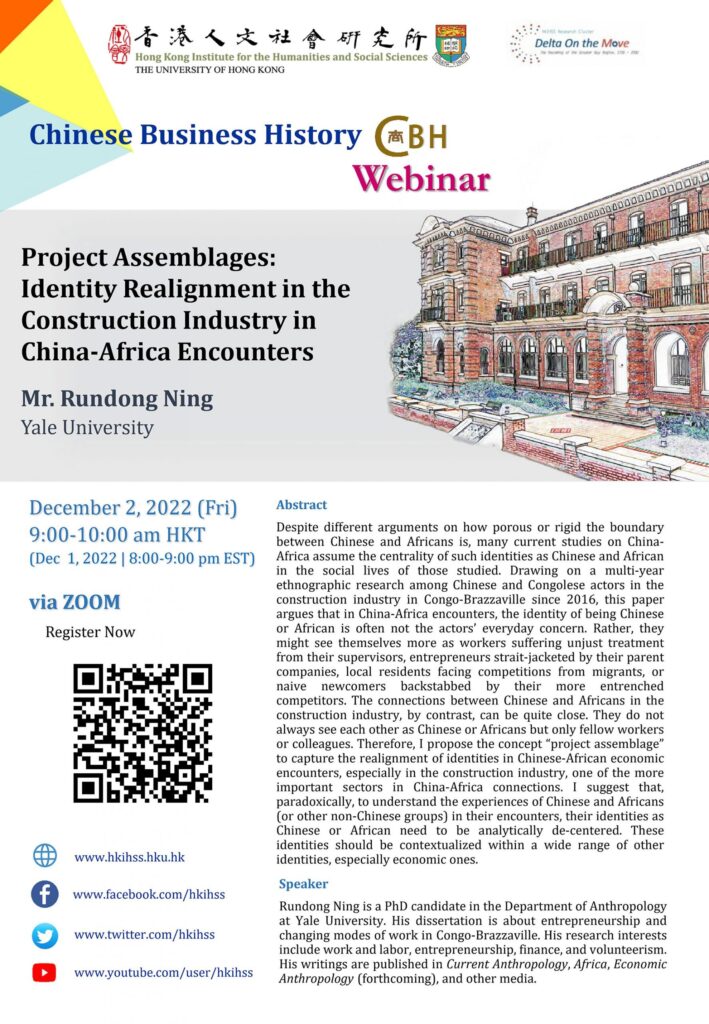
- December 2, 2022, 9:00 – 10:00 am HKT
- December 1, 2022 | 8:00 – 9:00 pm EST
ABSTRACT
Despite different arguments on how porous or rigid the boundary between Chinese and Africans is, many current studies on China-Africa assume the centrality of such identities as Chinese and African in the social lives of those studied. Drawing on a multi-year ethnographic research among Chinese and Congolese actors in the construction industry in Congo-Brazzaville since 2016, this paper argues that in China-Africa encounters, the identity of being Chinese or African is often not the actors’ everyday concern. Rather, they might see themselves more as workers suffering unjust treatment from their supervisors, entrepreneurs strait-jacketed by their parent companies, local residents facing competitions from migrants, or naive newcomers backstabbed by their more entrenched competitors. The connections between Chinese and Africans in the construction industry, by contrast, can be quite close. They do not always see each other as Chinese or Africans but only fellow workers or colleagues. Therefore, I propose the concept “project assemblage” to capture the realignment of identities in Chinese-African economic encounters, especially in the construction industry, one of the more important sectors in China-Africa connections. I suggest that, paradoxically, to understand the experiences of Chinese and Africans (or other non-Chinese groups) in their encounters, their identities as Chinese or African need to be analytically de-centered. These identities should be contextualized within a wide range of other identities, especially economic ones.
ABOUT THE SPEAKER
Rundong Ning is a PhD candidate in the Department of Anthropology at Yale University. His dissertation is about entrepreneurship and changing modes of work in Congo-Brazzaville. His research interests include work and labor, entrepreneurship, finance, and volunteerism. His writings are published in Current Anthropology, Africa, Economic Anthropology (forthcoming), and other media.
CO-ORGANIZER
This is an event co-organized with the “Delta on the Move: The Becoming of the Greater Bay Region, 1700 – 2000” Cluster.