Table of Contents
Abstract
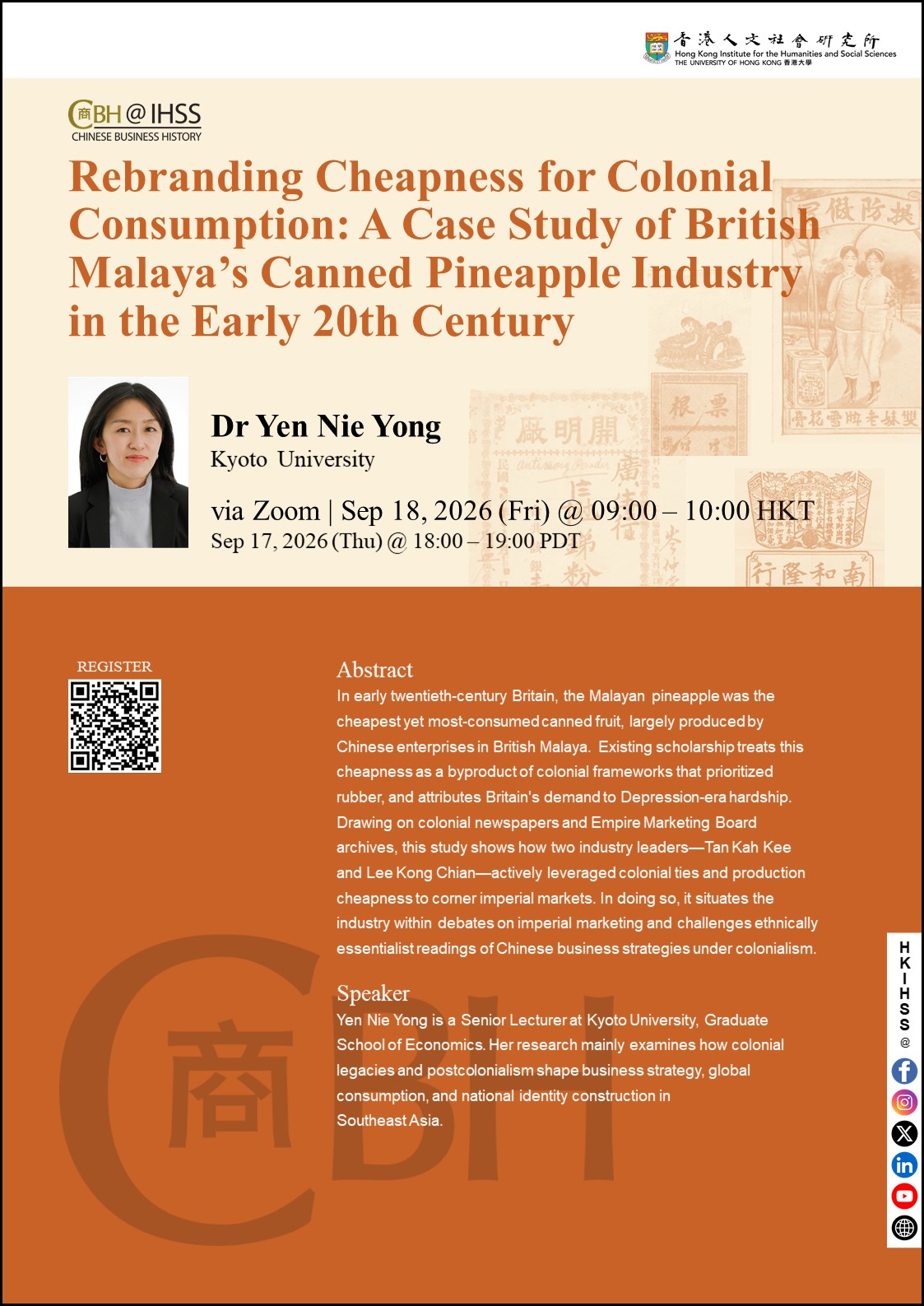
In early twentieth-century Britain, the Malayan pineapple was the cheapest yet most-consumed canned fruit, largely produced by Chinese enterprises in British Malaya. Existing scholarship treats this cheapness as a byproduct of colonial frameworks that prioritized rubber, and attributes Britain’s demand to Depression-era hardship. Drawing on colonial newspapers and Empire Marketing Board archives, this study shows how two industry leaders—Tan Kah Kee and Lee Kong Chian—actively leveraged colonial ties and production cheapness to corner imperial markets. In doing so, it situates the industry within debates on imperial marketing and challenges ethnically essentialist readings of Chinese business strategies under colonialism.
About the Speaker
Yen Nie Yong is a Senior Lecturer at Kyoto University, Graduate School of Economics. Her research mainly examines how colonial legacies and postcolonialism shape business strategy, global consumption, and national identity construction in Southeast Asia.
About the Webinar Series
This monthly webinar series features the newest research on the history of Chinese business and entrepreneurship. If you have any questions about this webinar series or would be interested in giving a talk, please contact Professor John D. Wong (jdwong@hku.hk) or Professor Ghassan Moazzin (gmoazzin@hku.hk).