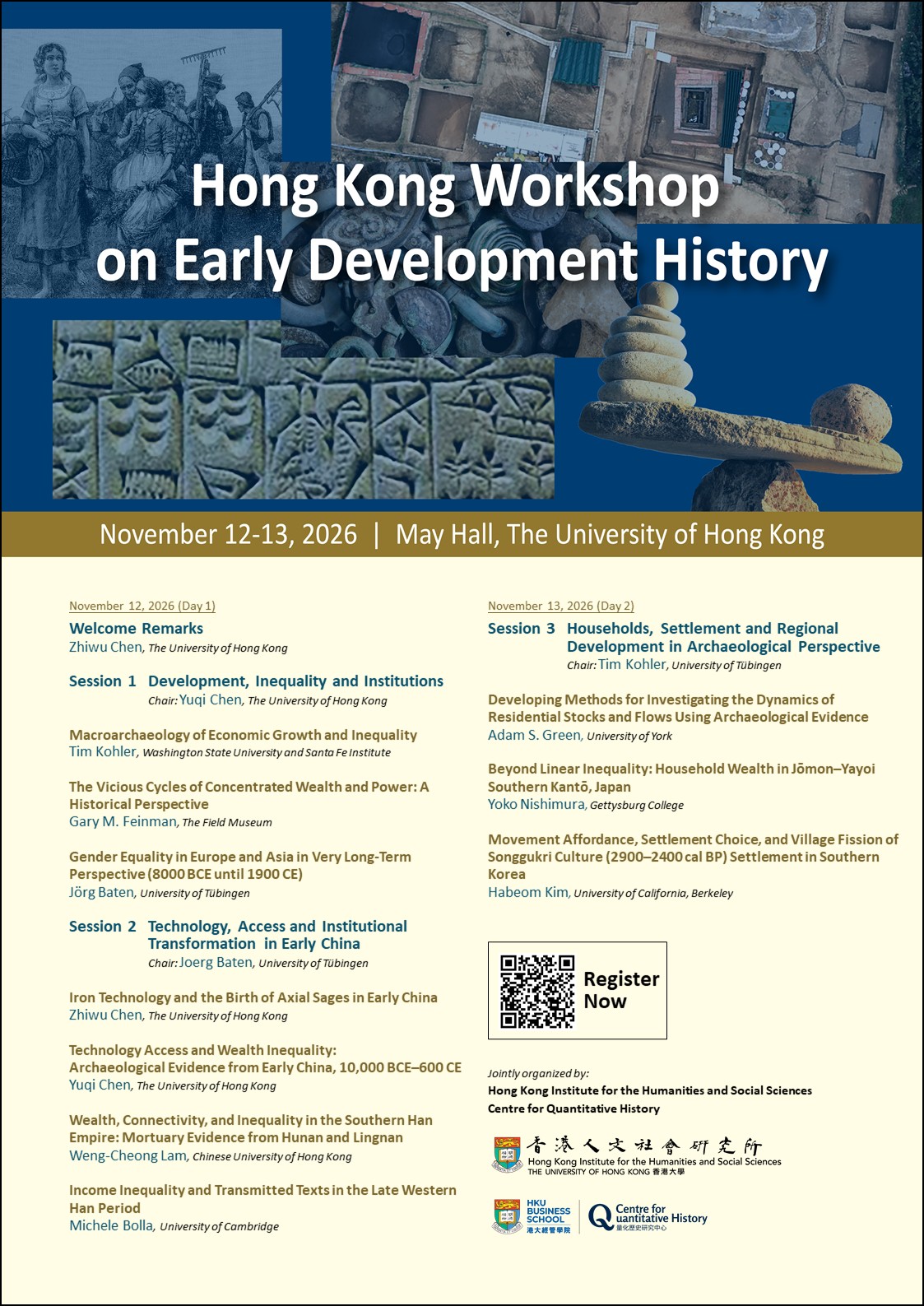
Hong Kong Workshop on Early Development History
November 12–13, 2026
May Hall, The University of Hong Kong
Jointly organized by HK Institute for the Humanities and Social Sciences and Centre for Quantitative History
Programme Rundown
Day 1 | Thursday, November 12, 2026
9:00–9:10 am
Welcome Remarks
Prof. Zhiwu Chen
The University of Hong Kong
Prof. Zhiwu Chen
The University of Hong Kong
9:10 am–12:10 pm
Session 1: Development, Inequality and Institutions
Chair: Yuqi Chen (The University of Hong Kong)
Macroarchaeology of Economic Growth and Inequality
Tim Kohler
Washington State University and Santa Fe Institute
Tim Kohler
Washington State University and Santa Fe Institute
The Vicious Cycles of Concentrated Wealth and Power: A Historical Perspective
Gary M. Feinman
The Field Museum
Gary M. Feinman
The Field Museum
11:20 am–12:10 pm
Gender Equality in Europe and Asia in Very Long-Term Perspective (8000 BCE until 1900 CE)
Jörg Baten
University of Tübingen
Jörg Baten
University of Tübingen
2:00–5:00 pm
Session 2: Technology, Access and Institutional Transformation in Early China
Chair: Jörg Baten (University of Tübingen)
Iron Technology and the Birth of Axial Sages in Early China
Zhiwu Chen
The University of Hong Kong
Zhiwu Chen
The University of Hong Kong
Technology Access and Wealth Inequality: Archaeological Evidence from Early China, 10,000 BCE–600 CE
Yuqi Chen
The University of Hong Kong
Yuqi Chen
The University of Hong Kong
Wealth, Connectivity, and Inequality in the Southern Han Empire: Mortuary Evidence from Hunan and Lingnan
Weng-Cheong Lam
Chinese University of Hong Kong
Weng-Cheong Lam
Chinese University of Hong Kong
Income Inequality and Transmitted Texts in the Late Western Han Period
Michele Bolla
University of Cambridge
Michele Bolla
University of Cambridge
Day 2 | Friday, November 13, 2026
9:00 am–12:10 pm
Session 3: Households, Settlement and Regional Development in Archaeological Perspective
Chair: Tim Kohler (Washington State University and Santa Fe Institute)
Developing Methods for Investigating the Dynamics of Residential Stocks and Flows Using Archaeological Evidence
Adam S. Green
University of York
Adam S. Green
University of York
Beyond Linear Inequality: Household Wealth in Jōmon–Yayoi Southern Kantō, Japan
Yoko Nishimura
Gettysburg College
Yoko Nishimura
Gettysburg College
Movement Affordance, Settlement Choice, and Village Fission of Songgukri Culture (2900–2400 cal BP) Settlement in Southern Korea
Habeom Kim
University of California, Berkeley
Habeom Kim
University of California, Berkeley
Paper Titles and Abstracts
1.
Gender Equality in Europe and Asia in Very Long-Term Perspective (8000 BCE until 1900 CE)
Jörg Baten, Manon Stephan and many others
Several regions in Europe and Asia were known for a particularly strong son bias, i.e., a strong preference for male offspring which resulted in providing more nutrients and health care to boys rather than to girls. Although inequality has been reduced during the second half of the 20th century, full equality has not yet been reached. Particularly striking was the son bias in East and South Asia during the late 19th and early 20th century, in which traditional cultural practices such as foot binding or widow burning had been associated with persistently low opportunities for women, and high gender inequality. Contemporaneous commentators suggested that these were cultural attitudes which did not change in the past, and would be difficult to change in the future. But was gender inequality really a cultural constant?
For the first time, we can now assess at which point in time high gender inequality developed historically and in which situations it was reduced or even reinforced. We assess the hypothesis that female contribution to household income was often crucial. For example, more mixed agriculture which cattle or even dairy farming had a role, the female contribution was larger and gender equality tended to be higher (in NW Europe, Alpine societies such as Slovenia, NE and SE Russia, Mongolia, and several other regions). We measure one crucial aspect of gender equality, namely resource provision during early childhood which is reflected in relative height of females and males, as well as in relative occurrence of enamel hypoplasia (a malnutrition indicator). We employ the largest sample of human remains ever collected for Eurasia, as well as the equally largest animal bone data set. Although many factors influence this relationship, an interaction of specialization on cattle and pastoral soil suitability has a statistically significant effect on gender equality, and changes over time are compatible. For example, the strong bias in China developed mainly in the 1100 to 1900 CE period, whereas China in the second millennium BCE had a relatively high gender equality.
For the first time, we can now assess at which point in time high gender inequality developed historically and in which situations it was reduced or even reinforced. We assess the hypothesis that female contribution to household income was often crucial. For example, more mixed agriculture which cattle or even dairy farming had a role, the female contribution was larger and gender equality tended to be higher (in NW Europe, Alpine societies such as Slovenia, NE and SE Russia, Mongolia, and several other regions). We measure one crucial aspect of gender equality, namely resource provision during early childhood which is reflected in relative height of females and males, as well as in relative occurrence of enamel hypoplasia (a malnutrition indicator). We employ the largest sample of human remains ever collected for Eurasia, as well as the equally largest animal bone data set. Although many factors influence this relationship, an interaction of specialization on cattle and pastoral soil suitability has a statistically significant effect on gender equality, and changes over time are compatible. For example, the strong bias in China developed mainly in the 1100 to 1900 CE period, whereas China in the second millennium BCE had a relatively high gender equality.
2.
Income Inequality and Transmitted Texts in the Late Western Han Period
Michele Bolla, Guido Alfani and Walter Scheidel
Transmitted texts such as the Shiji and Han Shu contain information on economic inequality, which, however, comes with large margins of uncertainty. This study quantifies these accounts, estimating income inequality at the demographic peak of the Western Han dynasty.
The core inputs of the estimation are recent estimates of GDP (ca. 2 CE), and new independently constructed estimates of the elite wealth and income distributions, obtained through calibrated power-law distributions. Uncertainty is modelled using a probabilistic approach, assigning probability density functions to key parameters such as grain prices and return rates on elite assets. Gini coefficients fall roughly within 0.415 and 0.495 across 95 percent of simulation runs.
The study includes a comparison with the Roman Empire. While income inequality (as measured by the Gini coefficient) was similar, inequality extraction was significantly higher in ancient China compared to the Mediterranean. This result applies to the empires at their demographic peaks: relative rankings need not be fixed in the long run.
The core inputs of the estimation are recent estimates of GDP (ca. 2 CE), and new independently constructed estimates of the elite wealth and income distributions, obtained through calibrated power-law distributions. Uncertainty is modelled using a probabilistic approach, assigning probability density functions to key parameters such as grain prices and return rates on elite assets. Gini coefficients fall roughly within 0.415 and 0.495 across 95 percent of simulation runs.
The study includes a comparison with the Roman Empire. While income inequality (as measured by the Gini coefficient) was similar, inequality extraction was significantly higher in ancient China compared to the Mediterranean. This result applies to the empires at their demographic peaks: relative rankings need not be fixed in the long run.
3.
Iron Technology and the Birth of Axial Sages in Early China
Zhiwu Chen, Senhao Hu and Sheng Zhou
The Axial Age (approximately 800–200 BCE) witnessed the simultaneous emergence of foundational philosophical and religious traditions across Eurasia—from Confucianism and Daoism in China to Greek philosophy, Zoroastrianism, Judaism, and Buddhism. While the temporal coincidence of these intellectual revolutions has long fascinated scholars, no material explanation has been systematically tested with quantitative evidence. This paper proposes and tests the hypothesis that the military adoption of iron technology was a key driver of the Axial Age’s philosophical innovations, focusing on early China (1046 BCE–9 CE). Using the China Archaeological Database (CADB) containing 557,421 grave goods from 51,352 sites, combined with biographical data on 507 philosophers, we construct a panel dataset of 487 grid cells (100 × 100 km) spanning four historical periods. Our results show that grid cells with iron weapon grave goods are significantly associated with greater philosopher emergence from 770 BCE onward. We identify three mechanisms: (1) escalated violence—both interpersonal and military—increased demand for new governance ideas; (2) violence-driven urbanization created intellectual incubators; and (3) expanding state size generated institutional demand for philosophical expertise. These findings hold under instrumental variable estimation, controls for competing hypotheses, and numerous robustness checks. Our study provides the first large-scale quantitative evidence linking technological change to one of humanity’s greatest intellectual transformations.
4.
Technology Access and Wealth Inequality: Archaeological Evidence from Early China, 10,000 BCE–600 CE
Yuqi Chen
A new technology can concentrate wealth in a few hands or spread it broadly. The difference lies less in the technology than in who can obtain its raw materials, expertise, and products. Using multiple archaeological wealth measures from early Chinese settlements over ten millennia, inequality rose into the Bronze Age, declined as iron spread, and later rebounded. Bronze abundance was most strongly associated with inequality when copper, tin, and casting were spatially concentrated, whereas broadly available iron was linked to lower inequality until a Han state monopoly eroded that access. This multi-proxy design complements global housing research. Across both metals, the pattern is the same: access, not the technology itself, shapes its distributional effects.
5.
The Vicious Cycles of Concentrated Wealth and Power: A Historical Perspective
Gary M. Feinman and Linda M. Nicholas
For centuries, social scientists have presumed that as human settlements and societies increase in demographic and political scale increases in the concentration of power and inequalities in wealth will inevitably be coupled and co-occur. Here, drawing on two large, collaborative and comparative studies, we illustrate that although increases in population raise the potential for greater disparities in wealth and power, they neither are always associated nor are they inevitable. The institutions of governance, and particularly how those institutions are funded, closely associate with the degrees to which power and wealth become concentrated. These correlations from the past parallel more recent historical episodes, holding potentially valuable lessons for the future. Rather than being inevitable outcomes of increases in scale or development, autocracy and inequality emerge through reinforcing fiscal and institutional feedback loops.
6.
Developing methods for investigating the dynamics of residential stocks and flows using archaeological evidence
Adam S. Green & Simon Mair
Understanding variability in the long-term dynamics of economic growth is essential to building a more sustainable future, but archaeologists have few methods for undertaking the systematic and quantitative comparison of past economies. The GINI project, a collaborative investigation into the long-term trajectory of economic inequality across the globe, applied the Gini coefficients to residence areas from archaeological sites. The GINI project revealed critical patterns of economic change, but it also laid the groundwork for explaining those patterns, proposing that average residence area can serve as a proxy for productivity in the past. In this paper, we build on this argument, using Material Flow Analysis (MFA), a method from ecological economics that can be used to characterise stocks and flows of materials and resources through past economies, or “social metabolisms.” We apply MFA to Wharram Percy, Mohenjo-daro, and other sites from the GINI database, finding instances of convergence and divergence between material inflow and productivity that can deepen our understanding of economic growth and sustainability.
7.
Movement Affordance, Settlement Choice, and Village Fission of Songgukri Culture (2900–2400 cal BP) Settlement in Southern Korea
Habeom Kim
This study investigates the spatial patterning of Songgukri culture (2900 – 2400 cal BP; also known as Middle Mumun culture) settlement across Southern Korea by examining topographic movement affordance. Using a probabilistic pedestrian travel model derived from a large number of least-cost paths on high resolution Digital Elevation Model (DEM), we quantify Constriction of Movement Freedom (CMF) as least-cost path density in the vicinity of each settlement. CMF indexes the degree to which slope channels pedestrian movement. Settlements in the Songgukri culture’s presumed homeland, the middle-lower Geum River, tend to be correlated with low CMF values, indicating low topographic constraint. Regional early phase of Songgukri occupation is estimated from summed probability distributions of 14C dates from reliable Songgukri cultural context. Regions with CMF values similar to the Geum M-L homeland tend to show earlier estimated occupation activity. This suggests that topographic movement affordance influenced settlement choice and, more broadly, the expansion of the Songgukri culture. Finally, this study explores village fission as a possible mechanism for the rapid regional expansion of Songgukri culture, arguing that relatively low economic inequality and the absence of strong hierarchical social-integrative institutions may have facilitated the fissioning of villages.
8.
Macroarchaeology of Economic Growth and Inequality
Tim Kohler & Scott Ortman
We probe the structure (using HGAMs) and dynamics of the economic growth/inequality relationship in the 12 strongest regions of GINI. Overall, Ginis is positively and significantly correlated with Mean Log House Size using century-long bins from each region. Five regions display persistently higher inequality than anticipated by the regression models; 5 are persistently lower; and two do not display significant departures from the expectation. A positive relationship between growth and inequality is strongest in the Southern Andes, Southwest North America, Central Mexico, and Southeast Europe; in Britain there is a moderate positive relationship between the two. In East Asia and Southeast North America higher-than-usual productivity is associated with lower, rather than higher, inequality. In 5 other regions there is no convincing relationship between growth and inequality in our sample. We examine the dynamics in two different ways, most uniquely in identifying how shocks of four types (production increases/decreases or inequality increases/decreases) affected each of these regions after one century, finding strong contrasts between the responses to a productivity decrease and an inequality increase with responses to other shocks less patterned. Overall, we argue that anthropology needs to re-embrace growth—abandoned in the 1950s—and consider its independent role in complexification and increasing inequality.
9.
Beyond Linear Inequality: Household Wealth in Jōmon–Yayoi Southern Kantō, Japan
Yoko Nishimura
This study examines long-term changes in material wealth inequality from the Jōmon to the Yayoi period in southern Kantō, Japan (ca. 3000 BC–AD 250), using 1,896 pit dwellings from 49 archaeological sites. Pit-dwelling floor area is used as a proxy for household wealth, and Gini coefficients are calculated to assess inequality over time. Wealth inequality was relatively low during the late Middle Jōmon, increased modestly in the Late Jōmon, declined slightly during the Middle Yayoi, and rose sharply in the Late Yayoi, when average dwelling size decreased substantially. These results suggest that inequality did not increase steadily with growing social complexity but instead followed a fluctuating rather than linear trajectory. In southern Kantō, these long-term fluctuations may have been associated with demographic change, settlement reorganization, the expansion of irrigated rice agriculture, and access to iron tools.
10.
Wealth, Connectivity, and Inequality in the Southern Han Empire: Mortuary Evidence from Hunan and Lingnan
Weng-Cheong Lam
This study examines wealth differentiation in the southern territories of the Han Empire, focusing on mortuary evidence from Hunan, Guangdong, and Guangxi. It compares multiple indicators of wealth, including tomb form and scale, the quantity and diversity of grave goods, and access to imported or exotic objects. These are further examined alongside mortuary practices and material traits conventionally associated with Han and local cultural traditions. The study asks whether material wealth, access to long-distance exchange networks, and participation in Han cultural practices were closely correlated. The results suggest that wealth differentiation cannot be explained simply as a division between affluent Han settlers and poorer local populations. Instead, wealth, connectivity, and cultural affiliation intersected in more complex ways and varied regionally. This provides a new perspective on how inequality was created and distributed during the expansion and consolidation of Han rule in southern China.