- Language: English
- Lecture Hall, May Hall, HKU Campus
- June 23 – 24, 2023
About the Symposium
The Symposium on New Frontiers and Directions in Chinese History 2023 is a two-day event on June 23 – 24, 2023, showcasing the latest research in Chinese history. Keynote speeches and discussions, convened by Professor Zhiwu Chen and Professor Guoqi Xu, will cover late imperial China, the old and new orders, Chinese business history, and conflict from within. The symposium will conclude with a closing keynote speech on archaeological data and Chinese history. Invitees can attend exclusive lunch and dinner events, providing great networking opportunities. The event is co-organized by the Hong Kong Institute for the Humanities and Social Sciences (HKIHSS) and the HKU Department of History (HKU History), and co-sponsored by the Louis Cha Fund for Chinese Studies and East/West Studies, with the partnership of the Centre for Quantitative History of HKU Business School. It will take place at the historic May Hall on the HKU campus, making it a must-attend event for scholars, researchers, teachers, and students working in the field of Chinese history.
Program Rundown
June 23, 2023 (Friday) – Day 1
| 8:15 | Registration starts with refreshments |
| 9:00 – 9:10 | Welcome Remarks
|
| 9:10 – 9:30 | Opening Remarks
|
| 9:30 – 10:30 | Opening Keynote SpeechThe Chinese Century? The Revival and Rise of Chinese Universities “The Chinese Century? The Revival and Rise of Chinese Universities” explores the remarkable growth of higher education in China. From enrolling approximately 860,000 students in 1978, Chinese universities have experienced exponential growth, with over thirty million students enrolled by 2010 and more than forty million in 2020. The expansion of higher education is altogether new in its scope, but it is also a modern manifestation of centuries of dedication to advanced learning. To understand the Chinese higher education sector today, we must first look back at its foundations in imperial and Republican China.
|
| 10:30 – 10:45 | Coffee Break |
| 10:45 – 12:45 | Late Imperial China Staging Hong Kong (Studies) in Chinese History Recent years have witnessed rejuvenated interests in Hong Kong, a fascinating research site not only for its inherent appeal but also for its significance in broader geopolitical dynamics. When China was closed to foreign travel, early scholarly attention studied Hong Kong as a proxy for such issues as Chinese lineage and society. In the period leading up to the handover in 1997, interest in Hong Kong has flourished, turning the focus to local Hong Kong. Building on these Hong Kong-centered studies, recent projects have emphasized the instrumentality of Hong Kong in directing regional and global flows. Compared to this historiographical trajectory, Hong Kong owed its geopolitical and economic significance to its role as China’s outlet during the Cold War, and the city has found it necessary to refashion itself since China’s Reform era. To maintain the city’s vitality, Hong Kong will have to assert its function as a regional and global hub, especially as shifting geopolitics and COVID rewire international circuitries. Interlacing such historiographical trajectory with historical developments, this talk explores Hong Kong’s opportunities and challenges in our world today.
Sports for National Rejuvenation or National Salvation: How Chinese and Americans Turned to Sports for National Developments at the Turn of the 20th Century This paper focuses on following three questions: why was the period of from 1890 to 1920 so important in both Chinese and American history? Why can a sports perspective help us better understand the history of Chinese and Americans at the turn of the 20th century? And how sports became a vehicle for Chinese national salvation during 1890 and 1920 while at the same time Americans embraced sports as new frontier and for national rejuvenation? The major objective of this paper is to demonstrate there was a strong shared theme and journey between Chinese and Americans in their respective formative national history through the lens of sports.
|
| 13:00 – 15:00 | Lunch (By Invitation Only) |
| 15:30 – 17:30 | The Old Order and The New Engendering Chinese History from Tianjin to Hong Kong Through discussing her award-winning book Dwelling in the World: Family, House, and Home in Tianjin China, 1860-1960, Dr. Elizabeth LaCoutureintroduces how gender representation of both scholars and methods can illuminate new directions in Chinese history. While feminist theory was an early innovator in interdisciplinary scholarship, feminist methods introduce alternative ways to compile and read an archive. As access to archives has become increasingly challenging, especially during the pandemic, feminist archival practices, such as memoir or material culture, may prove useful. The talk will focus on three case studies from Republican-era Tianjin that demonstrate how people wrote their stories through their dwelling. Bringing together diverse sources from architecture, women’s memoir, and the archives the talk will highlight how individual identities at the intersections of gender and class changed in urban China during the Republican era.
Translating the Declaration of Independence: American Frontiers of Good Governance in the Era of Opium Wars In 1838 the US missionary Rev. Elijah C. Bridgman introduced the Declaration of Independence to Qing-era readership in <美理哥合省國志略>. Revisiting Bridgman’s Chinese publication and subsequent revision of the Declaration opens a potential for scholarship to consider the rhetorical charge of the frontier as a point of intercultural reference. Bridgman’s translation also focuses attention on the importance of media in inter-imperial contexts of commerce that shaped development of “international law.”
|
| 18:00 | Dinner (By Invitation Only) |
une 24, 2023 (Saturday) – Day 2
| 9:15 | Registration starts with refreshments |
| 10:00 – 12:00 | Chinese Business History A Glimpse into the 1929 Corporate Performance in the Book Industry: A Comparative Analysis of Balance Sheets of Two Companies in New York and Shanghai Although there was no relation between the two, The Macmillan Company in New York and The Commercial Press in Shanghai were each considered among the largest corporations in the book industry in their respective countries in the 1920s. In this study we examine the companies’ 1929 balance sheets and take a glimpse into how they were doing financially 30 years after they were incorporated. Our purpose is twofold; first, to find out what the balance sheet can tell about the corporate performance, and secondly, to enhance their corporate narratives with financial data.
From Huasheng to Huawei: The Origins of the Chinese Electrical and Electronics Industries Before 1937 In my presentation, I will introduce my current research and book project on the historical development of the Chinese electrical and electronics industries in pre-war China. The first part of the presentation will introduce the general questions, themes and historical actors the project focuses on and situate it in relation of the Chinese electrical and electronics industries today. In the second half of the presentation, I will then discuss the beginnings of the Chinese electrical lamp industry, more specifically, the case of the Chinese Oppel Electric Manufacturing Co. Ltd., to further illustrate the aims and significance of the project.
|
| 12:30 – 14:30 | Lunch (By Invitation Only) |
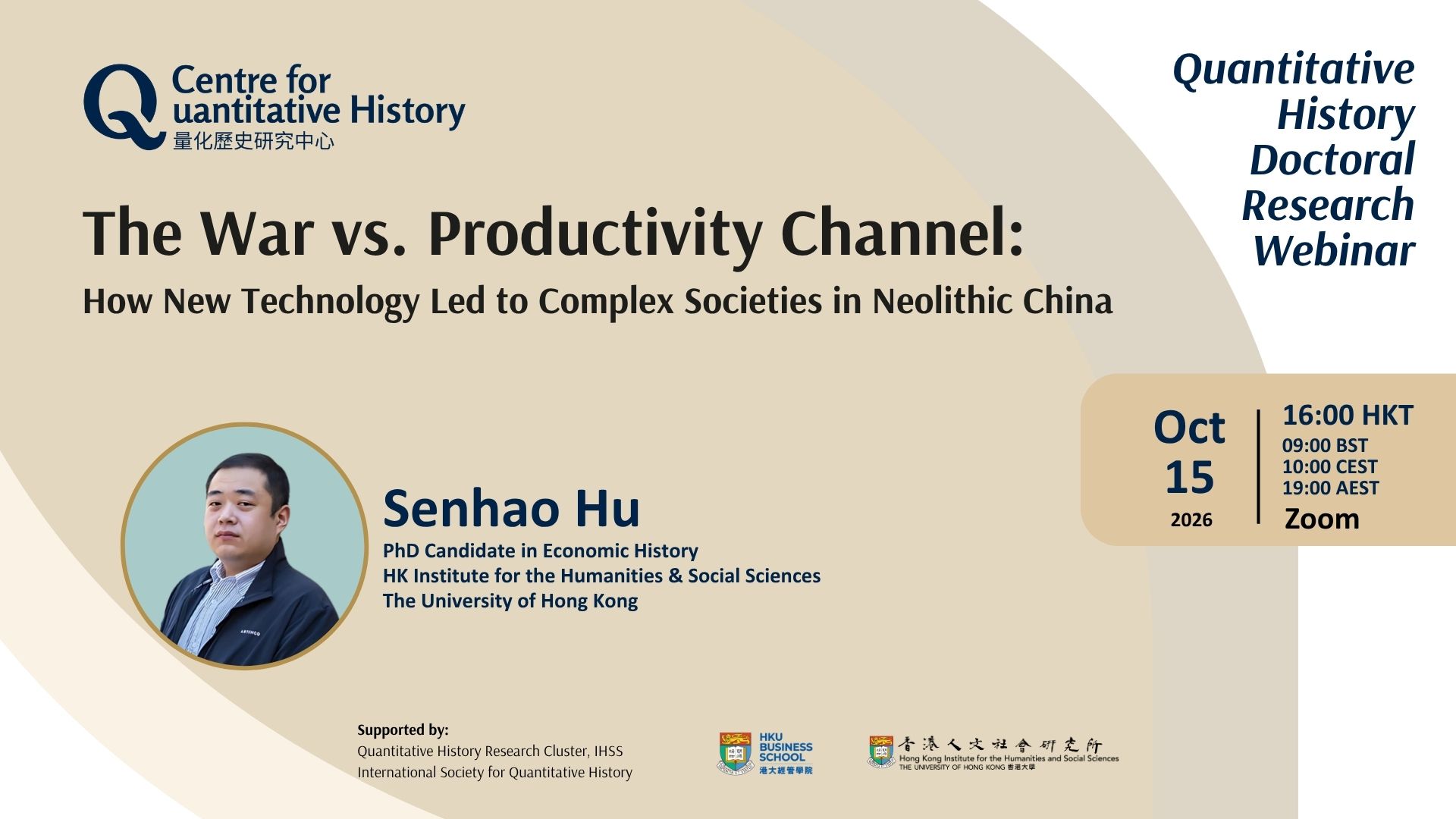
| 15:00 – 17:00 | Conflict from Within States and Wars: China’s Long March towards Unity and its Long-Term Consequences, 750 BC – 1911 AD Based on the compilation of a large geocoded annual data series of political regimes and incidences of warfare between 221 BC and 1911 AD, we show that the mythical historical Chinese rests in a tripartite synthesis of China’s unique geography (of environmental circumscription), ideology (of a single unified ruler for all) and institution (of direct administrative rule). Our paper provides a first direct quantification of ideology based on the application of the latest textual analysis of Classical Chinese primary sources. Our econometric exercise shows that the mechanism of China’s unity under this tripartite synthesis is forged through nomadic-agrarian warfare.
Rethinking China under Mao The talk provides an overview of the burgeoning historiography of the People’s Republic of China, especially of the early period between 1949 and 1978, and suggests how we might integrate such work into narratives of the Chinese past and present. In working through the research of the past decades the findings not only help us identify new areas of research, they rephrase some of the initial questions. The presentation will highlight areas in which reconsidering PRC history seems especially necessary: transnational flows, violence and social transformation.
|
| 17:00 – 18:00 | Closing Keynote Speech What Can Archaeological Data Tell Us About Chinese History? As Mark Twain put it, history doesn’t repeat itself, but it often rhymes. However, how far back should we go to better understand modern China? Skinner (1985) took us back to the 8th–13th centuries and found that today’s China came into shape during the Tang and Song China. Chen, Kung and Ma (2020) demonstrate that prefectures that did well in the keju exam during the Ming and Qing dynasties are still doing better today. So, is the Ming, or even the Tang, far back enough for understanding the present? Now with vast archaeological data available, we can investigate how much of modern China was already shaped during the late Neolithic era.
|
| 18:30 | Dinner (By Invitation Only) |
This symposium program is subject to change without prior notice. Lunch and dinner are by invitation only.
Organizers
The symposium is co-organized by the Hong Kong Institute for the Humanities and Social Sciences (HKIHSS) and the HKU Department of History (HKU History), and co-sponsored by the Louis Cha Fund for Chinese Studies and East/West Studies, with the partnership of the Centre for Quantitative History of HKU Business School.
Enquiries
ihss@hku.hk / hilsonng@hku.hk (Ms. Hilson Ng)