Table of Contents
Abstract
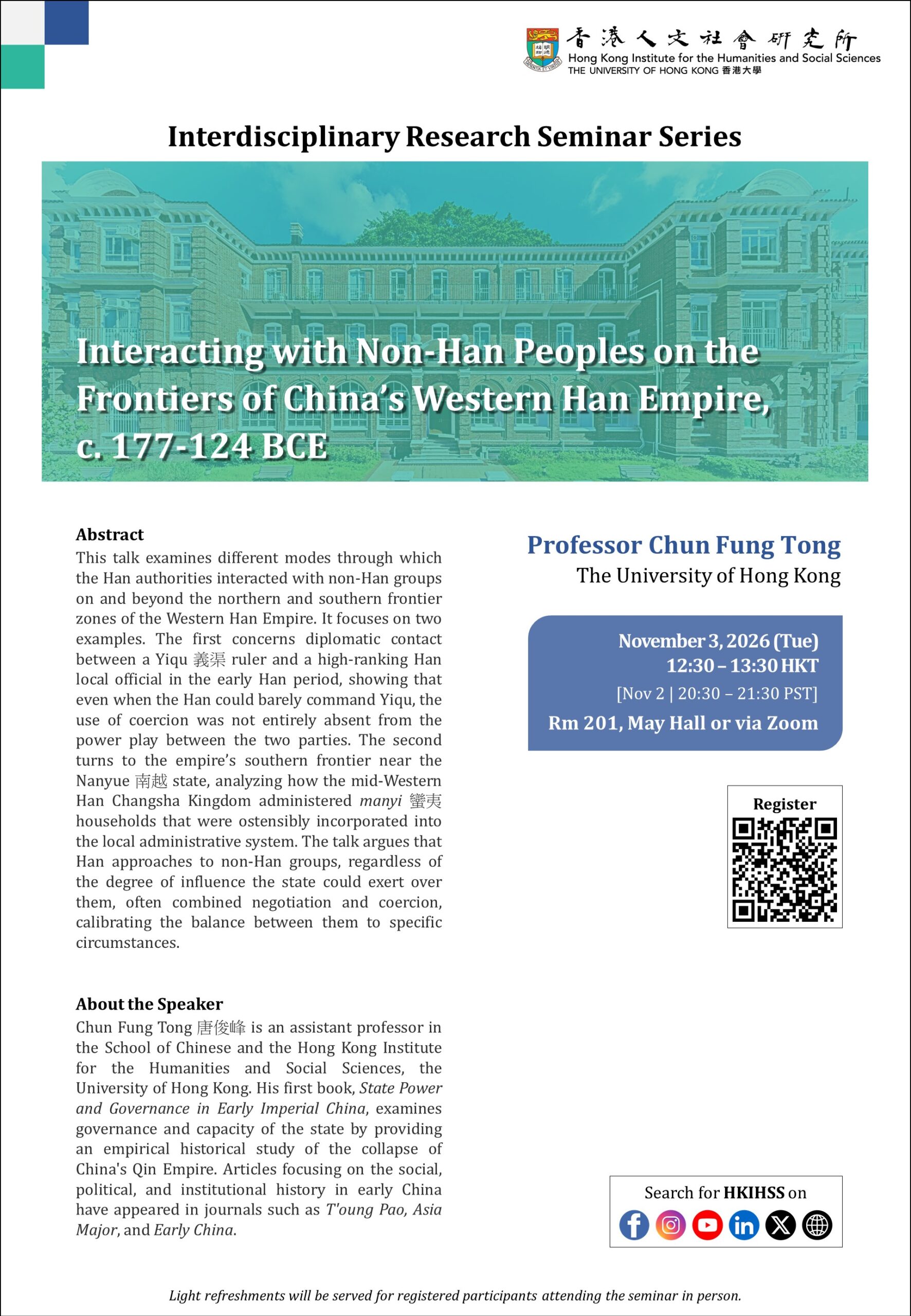
This talk examines different modes through which the Han authorities interacted with non-Han groups on and beyond the northern and southern frontier zones of the Western Han Empire. It focuses on two examples. The first concerns diplomatic contact between a Yiqu 義渠 ruler and a high-ranking Han local official in the early Han period, showing that even when the Han could barely command Yiqu, the use of coercion was not entirely absent from the power play between the two parties. The second turns to the empire’s southern frontier near the Nanyue 南越 state, analyzing how the mid-Western Han Changsha Kingdom administered manyi 蠻夷 households that were ostensibly incorporated into the local administrative system. The talk argues that Han approaches to non-Han groups, regardless of the degree of influence the state could exert over them, often combined negotiation and coercion, calibrating the balance between them to specific circumstances.
About the Speaker
Chun Fung Tong 唐俊峰 is an assistant professor in the School of Chinese and the Hong Kong Institute for the Humanities and Social Sciences, the University of Hong Kong. His first book, State Power and Governance in Early Imperial China, examines governance and capacity of the state by providing an empirical historical study of the collapse of China’s Qin Empire. Articles focusing on the social, political, and institutional history in early China have appeared in journals such as T’oung Pao, Asia Major, and Early China.
About the Interdisciplinary Research Seminar
This series aims to introduce a wide range of cutting-edge research in various disciplines and areas. If you have any questions about this seminar or would be interested in giving a talk, please contact Professor Chun Fung Tong (tong.chunfung@hku.hk).