

- Language: English
- Lecture Hall, G/F, May Hall
- September 13, 2024 (Friday) 16:00– 17:30 HKT
- candytse@hku.hk
ABSTRACT
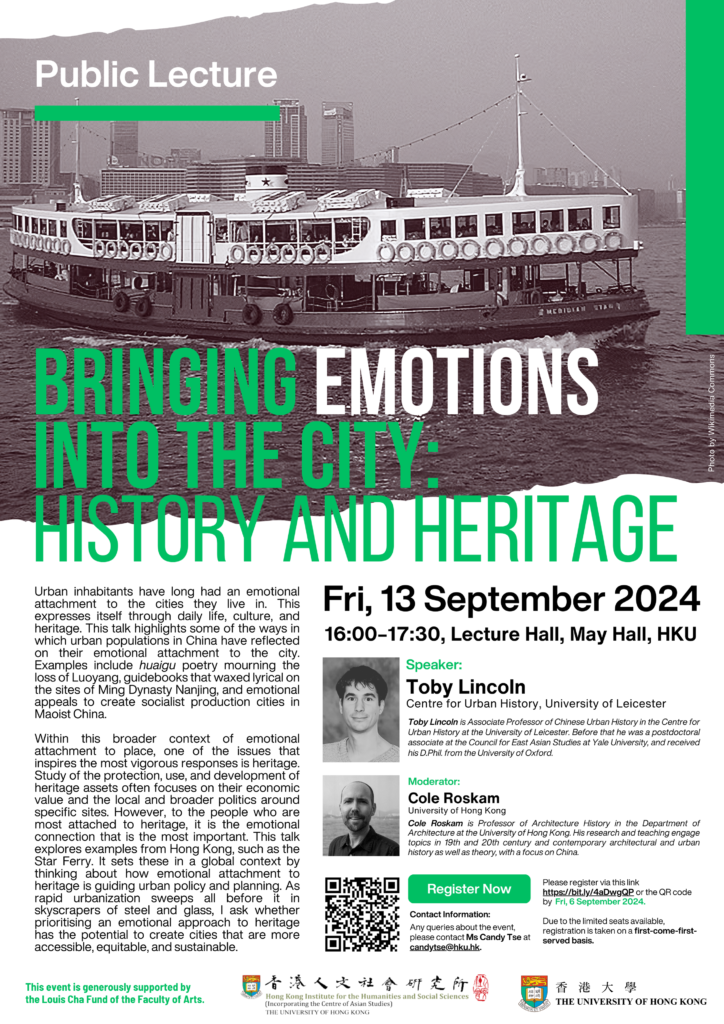
Urban inhabitants have long had an emotional attachment to the cities they live in. This expresses itself through daily life, culture, and heritage. This talk highlights some of the ways in which urban populations in China have reflected on their emotional attachment to the city. Examples include huaigu poetry mourning the loss of Luoyang, guidebooks that waxed lyrical on the sites of Ming Dynasty Nanjing, and emotional appeals to create socialist production cities in Maoist China.
Within this broader context of emotional attachment to place, one of the issues that inspires the most vigorous responses is heritage. Study of the protection, use, and development of heritage assets often focuses on their economic value and the local and broader politics around specific sites. However, to the people who are most attached to heritage, it is the emotional connection that is the most important. This talk explores examples from Hong Kong, such as the Star Ferry. It sets these in a global context by thinking about how emotional attachment to heritage is guiding urban policy and planning. As rapid urbanization sweeps all before it in skyscrapers of steel and glass, I ask whether prioritising an emotional approach to heritage has the potential to create cities that are more accessible, equitable, and sustainable.
BIOGRAPHY
Toby Lincoln is Associate Professor of Chinese Urban History in the Centre for Urban History at the University of Leicester. Before that he was a postdoctoral associate at the Council for East Asian Studies at Yale University, and received his D.Phil. from the University of Oxford. His publications include two books. The first, Urbanizing China in War and Peace: the case of Wuxi County (2015), explores urbanisation in Jiangnan in the first half of the 20th century. The second, China An Urban History (2021), writes the history of China’s cities into the global story of how we are now living on an urban planet. It shows how despite being an agricultural society for thousands of years China had a dynamic urban culture, which has been transformed into the largest urban society on earth over the course of the last two hundred years.
Toby’s current research focuses on how Chinese cities were reconstructed after WWII. Taking an explicitly comparative approach with Japan, the USSR, and countries in Europe, the project shows how Chinese rebuilt physical infrastructure, managed the return of millions of refugees, and came to terms with the trauma caused by many long years of war. Toby’s other research interests include urban heritage in China and questions of urban sustainability during the Anthropocene.
Paul Seabright teaches economics at the Toulouse School of Economics, and until 2021 was director of the multidisciplinary Institute for Advanced Study in Toulouse. From 2021 to 2023, he was a Fellow of All Souls College at the University of Oxford. HIs books include The War of the Sexes: How Conflict and Cooperation Have Shaped Men and Women from Prehistory to the Present, and The Company of Strangers: A Natural History of Economic Life (both Princeton).
Please register by Friday 6 September 2024.
Due to the limited seats available, registration is taken on a first-come-first-served basis.


